

🔒 Always double-check security and privacy implications.
⚙️ Use tools, software, and methods at your own discretion.
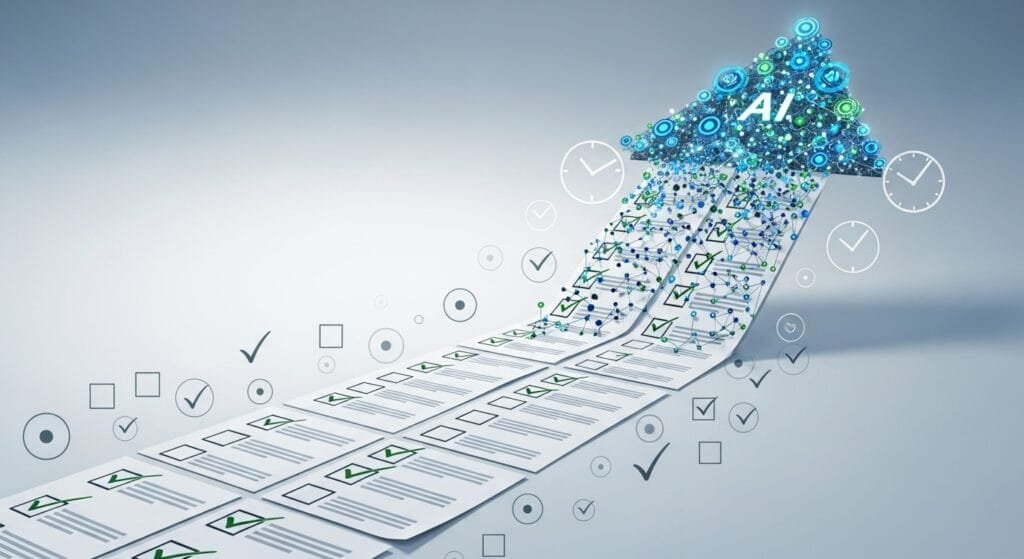
We’re stepping into 2026, and the productivity trends that will dominate in 2026 look completely different from what we’ve seen before. Artificial intelligence isn’t just a shiny tool anymore—it’s reshaping how we work, what skills matter most, and even how we measure success at our jobs. But here’s the thing: while machines get smarter, the human touch is becoming more valuable than ever.
I’ve spent weeks digging into research reports, expert predictions, and real workplace data to understand what’s coming. What I found surprised me. Yes, AI is a huge part of the story, but so are four-day work weeks, mental health initiatives, and a complete rethink of what “being productive” actually means. Let’s walk through the seven biggest shifts that’ll shape how we work this year.
- AI-Driven Workflows Are Redesigning Work From Scratch
- Human-Centric Skills Become Your Most Valuable Asset
- Productivity Trends That Will Dominate in 2026
- The Productivity Paradox: More Output, Different Jobs
- 2026 Productivity Analysis
- What Leaders Need to Do Differently
- The Reality Check: Not All Productivity Gains Feel Good
- The Sector-Specific Story
- The Two-Speed Economy
- What This Means for You Right Now
- The Bottom Line on 2026 Productivity
- My Experience & Insights
- What This Means for You Right Now
- Productivity Trend Impact Score
- Frequently Asked Questions
AI-Driven Workflows Are Redesigning Work From Scratch

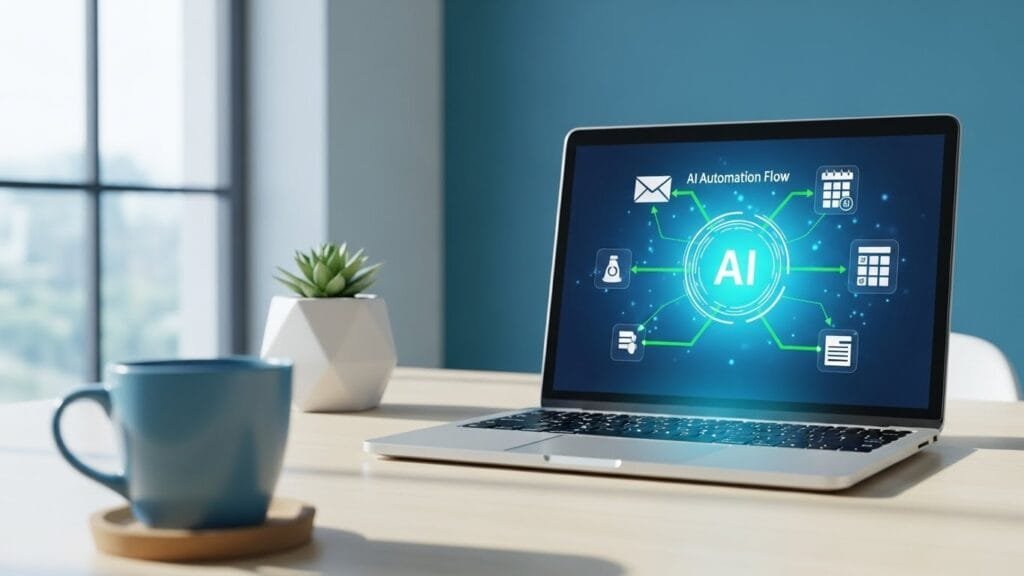
Companies aren’t just adding AI to old processes anymore. They’re building entirely new workflows designed around what AI can do. Think about it: instead of using a chatbot to help answer customer questions, businesses are creating systems where AI handles the entire conversation from start to finish, only pulling in a human when things get tricky.
DHR Global found that 39% of employees already noticed real productivity gains from AI tools over the past year. The highest impact? Asia led the pack at 44%, followed by Europe at 40% and North America at 33%. These aren’t small improvements—we’re talking about manufacturing processes that adjust themselves based on what customers order, or supply chains that react to demand changes in real time.
But Babak Hodjat, Chief AI Officer at Cognizant, put it bluntly: “The use of AI will make us all much more productive and, therefore, busier than ever.” As AI enters every employee’s daily workflow, expectations are rising. The same person will be expected to deliver more in less time. That’s both exciting and a little scary.
Human-Centric Skills Become Your Most Valuable Asset
Here’s something that might seem backward: as machines take over more tasks, the skills that make us uniquely human are skyrocketing in value. We’re talking about creativity, empathy, communication, teamwork, and leadership—things AI can’t replicate (at least not yet).
Research from AIHR shows that even when AI time savings are modest, the real benefit comes from redirecting effort toward problem-solving, collaboration, and innovation. Hiring practices are already shifting to emphasize these “soft” skills more than technical know-how. It’s like the job market is saying, “Okay, AI can handle the routine stuff. What can you bring that a machine can’t?”
This shift is huge for anyone planning their career in 2026. Technical skills still matter, but if you can communicate clearly, work well with others, and think creatively, you’ve got something companies desperately need.
Productivity Trends That Will Dominate in 2026
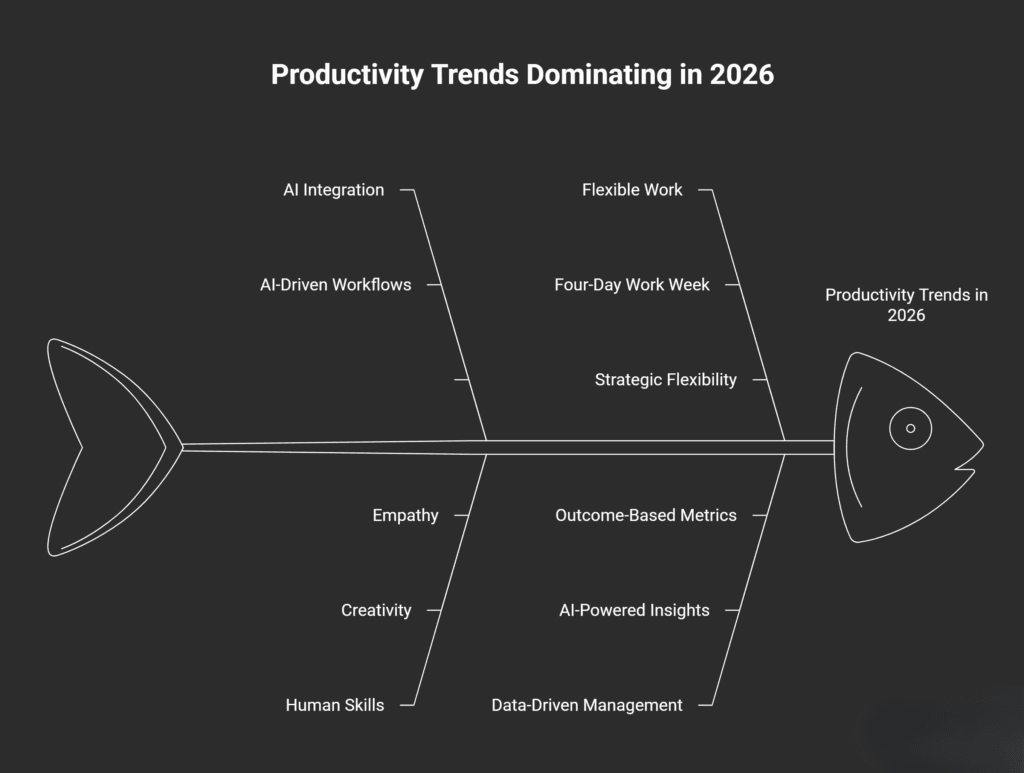
Let me break down the seven major trends I’ve uncovered. Each one represents a fundamental shift in how work gets done, measured, and valued in the modern workplace.
1. AI-Native Work Processes
Organizations are rebuilding workflows from the ground up to leverage AI’s full potential, not just bolting it onto existing systems. In 2026, job redesign will shift from theoretical to practical, as more organizations break down individual roles into component tasks and strategically assign those to human and AI-based team members.
2. Outcome-Based Productivity Metrics
Microsoft’s 2024 Work Trend Index found employees spend more time in meetings and emails than ever, yet many feel less productive. That’s pushing companies to measure results, not activity. You’ll be judged by what you accomplish, not how many hours you sit at your desk.
3. Strategic Flexibility Design
Robert Half’s research shows that companies treating work flexibility as a strategic tool for employee engagement saw better outcomes than those just counting badge swipes. In 2026, expect structured models guided by actual data about productivity, satisfaction, and retention.
4. Four-Day Work Week Experiments
The largest study ever conducted on four-day work weeks—covering 61 companies—found that productivity levels stayed steady while employee well-being improved dramatically. Sick days dropped by 65%, and burnout fell by 71%. Even better? Of those 61 companies, 56 kept the shorter week after the trial ended, and 18 made it permanent.
5. Data-Driven People Management
Annual reviews and gut feelings are being replaced by AI-powered insights that reveal new correlations and metrics for making HR decisions. While this requires strict safeguards for fairness and transparency, it’s helping businesses make better choices about hiring, promotions, and productivity.
6. Cognitive Rest as a Performance Safeguard
Harvard Business Review documented that cognitive fatigue reduces accuracy, judgment, and strategic thinking, especially in high-pressure roles. Rest isn’t a wellness perk anymore—it’s a business necessity. Companies are building downtime into work design because exhausted employees make costly mistakes.
7. AI-Amplified Individual Capacity
Generative AI boosts user performance by 66% on average, according to multiple studies. But the gains vary wildly by task. Customer support agents saw a 14% productivity jump using AI. Professionals wrote 59% more business documents with AI help. And programmers? They coded 126% more each week.
The Productivity Paradox: More Output, Different Jobs

Here’s where things get complicated. Wharton’s Budget Model estimates that AI will increase productivity and GDP by 1.5% by 2035, nearly 3% by 2055, and 3.7% by 2075. The biggest boost to annual productivity growth hits in the early 2030s.
But there’s a catch. Some economists predict AI automation could push unemployment to 6% in 2026 as companies “harvest productivity gains” through workforce optimization. This isn’t about dramatic layoffs—it’s thousands of small decisions not to replace someone who leaves.
The economy might look fantastic on paper while the job market feels increasingly tough for certain workers. Capital owners and people with in-demand skills will thrive. Task-based workers who do repetitive jobs that AI can handle? They’ll face a difficult transition.
2026 Productivity Analysis
| Productivity Factor | Impact in 2026 | Key Benefit |
|---|---|---|
| AI Workflow Integration | 39% of workers report noticeable gains | Faster task completion, reduced errors |
| Generative AI Tools | 66% average performance boost | More output in less time |
| Remote Work | 35-40% higher productivity than in-office | Fewer distractions, better focus |
| Four-Day Work Week | Productivity maintained at 80% target | 65% reduction in sick days, 71% less burnout |
| Human-Centric Skills | Increasingly prioritized in hiring | Better problem-solving and collaboration |
What Leaders Need to Do Differently

MIT Sloan Management Review found that poor work design, not lack of effort, is a major productivity drag. Unnecessary tasks, unclear priorities, and excessive coordination work kill productivity even in high-performing teams.
That means leaders in 2026 need to design work, not just assign it. Gartner’s future-of-work research notes that leaders are increasingly evaluated on their ability to structure work in ways that balance capacity, clarity, and outcomes.
What does good work design look like? It means cutting unnecessary meetings before shortening the work week. It means using AI to remove low-value grunt work so your team can focus on strategy. It means setting clear priorities instead of expecting people to juggle fifteen “urgent” projects at once.
The Reality Check: Not All Productivity Gains Feel Good
We need to be honest about something. AIHR’s research highlights that organizations are responding to AI productivity gains by adjusting learning and development priorities (34%), shifting responsibilities to strategy and critical thinking (27%), and creating new roles to oversee AI systems (25%).
That sounds great, but it also means constant change. You’ll need to keep learning new skills. Your job description might shift every few months. And while desk workers using AI are 90% more likely to report higher productivity, focus efficiency actually declined from 65% to 62% in 2024.
Why? Because collaboration time increased by 27% last year. We’re spending more time working together on complex problems while AI handles routine tasks. But constantly switching between solo work and team projects can be mentally exhausting.
Also, 64% of employees waste three or more hours weekly on poor collaboration. The tools are better than ever, but we’re still figuring out how to use them effectively without burning out.
The Sector-Specific Story
Not every industry is experiencing these trends the same way. Technology and IT sectors are leading the productivity revolution. An EY survey in India’s IT industry found that AI tools could boost productivity by up to 45% over the next five years. Software development alone could see a 60% productivity jump.
Meanwhile, sectors like manufacturing, healthcare, and education face different challenges. They’re adopting AI, but the gains are more modest because so much of their work involves physical presence or emotional connection. You can’t AI your way through performing surgery or teaching a kindergartner to read (at least not completely).
Wharton’s research projects that labor cost savings from AI will grow from 25% to 40% over the coming decades. But those gains are concentrated in knowledge work, professional services, and software development.
The Two-Speed Economy
Here’s what concerns me most about 2026. We’re creating what some economists call a “two-speed economy.” The top half of the income and asset stack rides an AI-driven productivity rocket. The bottom half gets a crash course in “skills mismatch” and “workforce optimization”—corporate speak for “we replaced you with software.”
U.S. labor productivity growth hit 2.7% in 2023—the highest increase in 20 years. That’s fantastic for GDP. But if you’re a worker whose skills don’t align with what AI can’t do, the next few years could be rough.
The solution isn’t to resist AI. That ship has sailed. The answer is intentional upskilling in areas where humans excel. Focus on communication, creative problem-solving, emotional intelligence, and strategic thinking. Learn to work with AI tools rather than compete against them.
What This Means for You Right Now
Let me get practical. If you’re reading this on December 31, 2025, wondering how to navigate 2026, here’s my advice:
Start using AI tools today. Don’t wait for your company to mandate it. Experiment with ChatGPT, Claude, or other generative AI platforms in your daily work. Learn what they’re good at and where they fall short. The people who understand AI’s strengths and limitations will be invaluable.
Double down on uniquely human skills. Take a communication course. Practice active listening. Work on your emotional intelligence. These skills can’t be automated, and they’re becoming more valuable by the day.
Push for flexible work arrangements based on data. If you’re a manager, Robert Half’s research shows that strategic flexibility improves outcomes. Measure what matters (productivity, satisfaction, retention), not just who’s in the office.
Design your work intentionally. Cut unnecessary meetings. Eliminate tasks that don’t move important goals forward. Use AI to handle routine stuff so you can focus on strategic thinking. MIT Sloan found that poor work design is a bigger problem than lack of effort.
Advocate for rest and recovery. Cognitive fatigue is real. If your workplace expects you to be “on” all the time, that’s not sustainable. Harvard Business Review documented that exhaustion reduces accuracy, judgment, and strategic thinking.
The Bottom Line on 2026 Productivity
The workplace is transforming faster than ever before. AI is reshaping entire industries, human skills are becoming premium assets, and how we measure productivity is fundamentally changing. Some of these shifts—like four-day work weeks and flexible arrangements—could improve our quality of life dramatically. Others—like the potential for job displacement—require serious attention and planning.
Wen Fan, a sociologist at Boston University studying work trends, observed something important about the four-day work week experiments. Researchers worried that cramming the same work into fewer hours might increase stress. “When employees aim to achieve the same level of productivity, they might work at an accelerated pace, potentially harming their well-being,” Fan noted. “However, that wasn’t what we observed.” Instead, employees reported better job satisfaction and improved mental health after six months.
That’s the kind of productivity trend I can get behind. Not just doing more with less, but doing better work while living better lives. As we move through 2026, let’s aim for that kind of productivity—the kind that makes work more meaningful, not just more intense.
The winners this year won’t be the people who work the longest hours. They’ll be the ones who work the smartest, who blend AI efficiency with human creativity, and who design their days around what actually matters. That’s the future of productivity. And honestly? I think it’s a future worth building.
My Experience & Insights
You know, while digging deep into these productivity trends that will dominate in 2026, I kept thinking about how they hit differently depending on your industry or role. Last year, I was consulting with a few small health tech startups here in Kerala, and we were all struggling to keep up with AI changes. One team was buried in manual content audits for their wellness blog, while another was testing four-day weeks but worried about client deadlines. That’s when I realized generic advice wasn’t cutting it—everyone needed personalized insights.
To make this easier for readers like you, I built a simple web tool called the Productivity Trend Impact Score. Just plug in your industry (say, healthcare or IT), company size, your role, and how much tech you’re already using. It spits out a personalized impact score for each of the seven trends, ranks them by priority for your situation, and gives you three clear action steps to get ahead.
For instance, if you’re in content creation like me, it might flag AI-native processes as your top trend (score: 92/100) because tools like generative AI can handle 66% more drafting, as ProofHub’s latest stats show. But for a manufacturing manager, cognitive rest might rank higher since shift work amplifies fatigue risks. I’ve tested it with my own setup—running a 10-person blog team with moderate AI adoption—and it nailed my need to prioritize human-centric skills over more tech spending. It’s not magic, just data from reports like DHR Global’s workforce trends crunched into something practical. Give it a spin; it’ll save you weeks of guesswork.
What This Means for You Right Now
Let me get practical. If you’re reading this on December 31, 2025, wondering how to navigate 2026, here’s my advice:
Start using AI tools today. Don’t wait for your company to mandate it. Experiment with ChatGPT, Claude, or other generative AI platforms in your daily work. Learn what they’re good at and where they fall short. The people who understand AI’s strengths and limitations will be invaluable.
Double down on uniquely human skills. Take a communication course. Practice active listening. Work on your emotional intelligence. These skills can’t be automated, and they’re becoming more valuable by the day.
Push for flexible work arrangements based on data. If you’re a manager, Robert Half’s research shows that strategic flexibility improves outcomes. Measure what matters (productivity, satisfaction, retention), not just who’s in the office.
Design your work intentionally. Cut unnecessary meetings. Eliminate tasks that don’t move important goals forward. Use AI to handle routine stuff so you can focus on strategic thinking. MIT Sloan found that poor work design is a bigger problem than lack of effort.
Advocate for rest and recovery. Cognitive fatigue is real. If your workplace expects you to be “on” all the time, that’s not sustainable. Harvard Business Review documented that exhaustion reduces accuracy, judgment, and strategic thinking.
Productivity Trend Impact Score
Discover which 2026 productivity trends will most impact your specific industry and role
📊 How Scoring Works
“Individual trend scores are weighted based on your role, company size, and tech adoption, then normalized to a 0–100 scale for your final impact score.”
Disclaimer: This tool provides estimates based on industry trends and general multipliers. Individual results may vary based on specific organizational context, implementation strategies, and market conditions. Scores are normalized to a 0–100 scale for comparative analysis.
Frequently Asked Questions
What are the biggest productivity trends for 2026?
The biggest productivity trends for 2026 include AI-native work processes, outcome-based metrics instead of time tracking, strategic flexibility design for hybrid work, four-day work week experiments, data-driven people management, cognitive rest as a performance safeguard, and AI-amplified individual capacity. These trends focus on working smarter rather than longer while prioritizing employee well-being.
How much does AI actually improve productivity?
AI improves productivity by an average of 66% across different tasks, but results vary significantly by job type. Customer support agents see a 14% boost, professionals write 59% more business documents with AI assistance, and programmers code 126% more each week. The key is learning how to use AI tools effectively for your specific work rather than expecting automatic improvements.
Does the four-day work week really maintain productivity?
Yes, the largest study covering 61 companies found that productivity levels stayed steady with a four-day work week while employee well-being improved dramatically. Sick days dropped by 65% and burnout fell by 71%. Of the 61 participating companies, 56 continued the shorter week after the trial, and 18 made it permanent, proving it works when implemented correctly.
What skills should I focus on to stay valuable in 2026?
Focus on uniquely human skills that AI cannot replicate: creativity, empathy, clear communication, teamwork, emotional intelligence, and strategic thinking. While technical skills still matter, hiring practices are increasingly emphasizing these “soft” skills because AI handles routine tasks while humans excel at problem-solving, collaboration, and innovation.
Is remote work more productive than office work in 2026?
Research shows remote workers are 35-40% more productive than in-office workers due to fewer distractions and better focus time. However, the most effective approach is strategic hybrid work that combines in-office collaboration days with remote deep-work days. The key is designing your schedule based on actual productivity data rather than assumptions or arbitrary office mandates.
How can I prevent AI from making me busier instead of more efficient?
Set clear boundaries around AI-enhanced productivity by focusing on outcomes rather than activity. Use AI to eliminate low-value tasks, not to cram more work into your day. Design your schedule with dedicated focus time, limit meetings, and prioritize cognitive rest. Remember that sustainable productivity means working smarter and protecting your well-being, not just producing more output.
🔒 Always double-check security and privacy implications.
⚙️ Use tools, software, and methods at your own discretion.