

🔒 Always double-check security and privacy implications.
⚙️ Use tools, software, and methods at your own discretion.
How AI is reshaping the 9-to-5 routine isn’t just a future possibility—it’s happening right now in offices across the country. If you’ve noticed your workweek feeling different lately, you’re not imagining things. Artificial intelligence has moved from the tech department’s experimental playground straight into our daily work lives, changing when we meet, how we focus, and what we actually spend our time doing.
We’re witnessing a fundamental shift in how work gets done. AI tools are handling the boring, repetitive stuff that used to eat up hours of our day. This means more time for the work that actually requires human creativity and problem-solving. But here’s the thing—this transformation goes way deeper than just saving a few minutes here and there.
- The New Rhythm of the Workweek
- From Doer to Manager
- Real Productivity Gains
- How Work Tasks Are Changing
- Traditional vs. AI-Enabled Workdays
- Work Methods Comparison
- Smarter Scheduling and Time Management
- The Four-Day Work Week Possibility
- Skills and Adaptation Required
- What This Means for Job Quality
- Connected Intelligence at Work
- Moving Forward
- My Experience & Insights
- AI Time-Savings Calculator
- Frequently Asked Questions
The New Rhythm of the Workweek

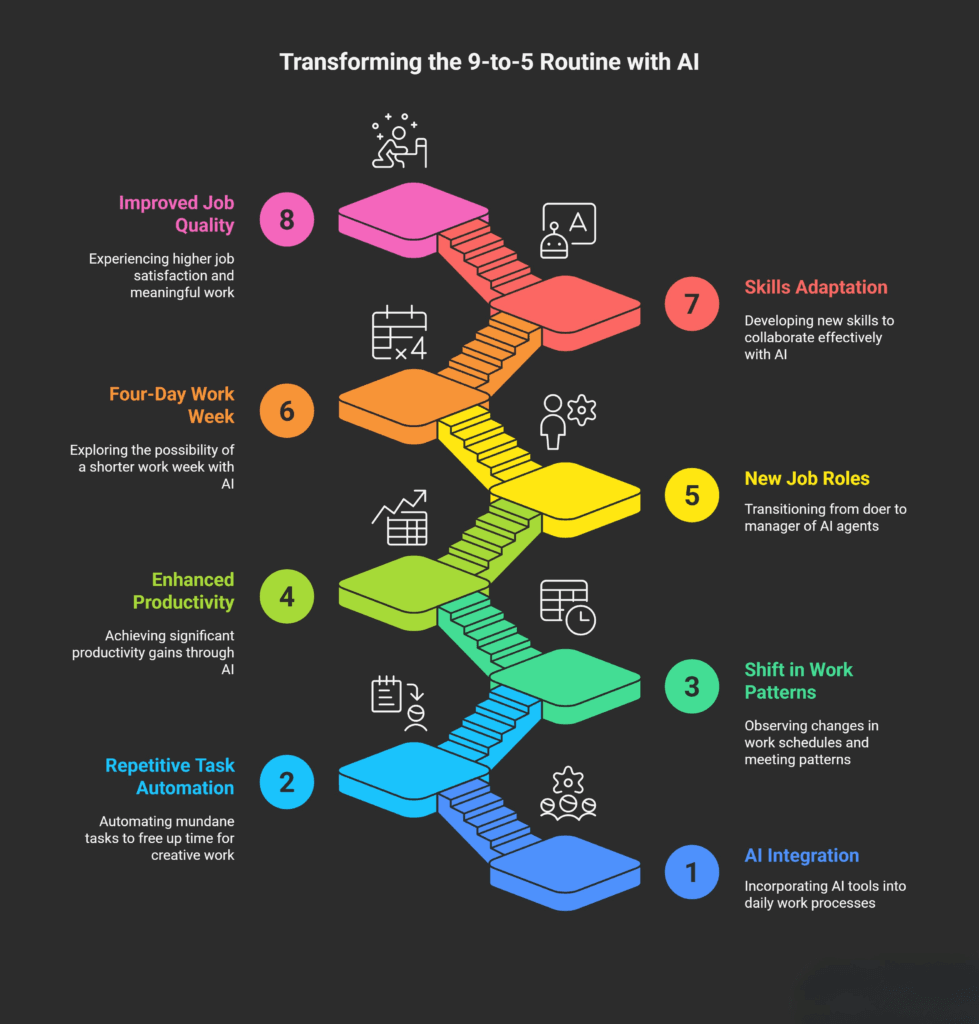
The traditional Monday-through-Friday grind is getting a serious makeover. Teams using AI are experiencing something surprising: their work patterns are shifting in ways nobody predicted. Meetings that used to scatter randomly across the week are now clustering toward the middle days. That leaves Mondays and Fridays open for deep, focused work—the kind that requires uninterrupted thinking time.
Jeanne C. Meister, a Future of Work Strategist and Forbes contributor, notes that at least 15% of routine work-related decisions will be made autonomously by AI through her research with HR leaders at Global 2,000 companies. This shift means employees can tackle high-value projects when they’re fresh on Monday mornings instead of drowning in admin tasks.
Engagement levels are climbing, too. When you’re not spending half your day on tedious tasks, you actually have energy left for meaningful work. It’s like finally getting that mental breathing room we’ve all been craving. AI-empowered organizations are starting the week feeling twice as productive and six times more focused.
From Doer to Manager
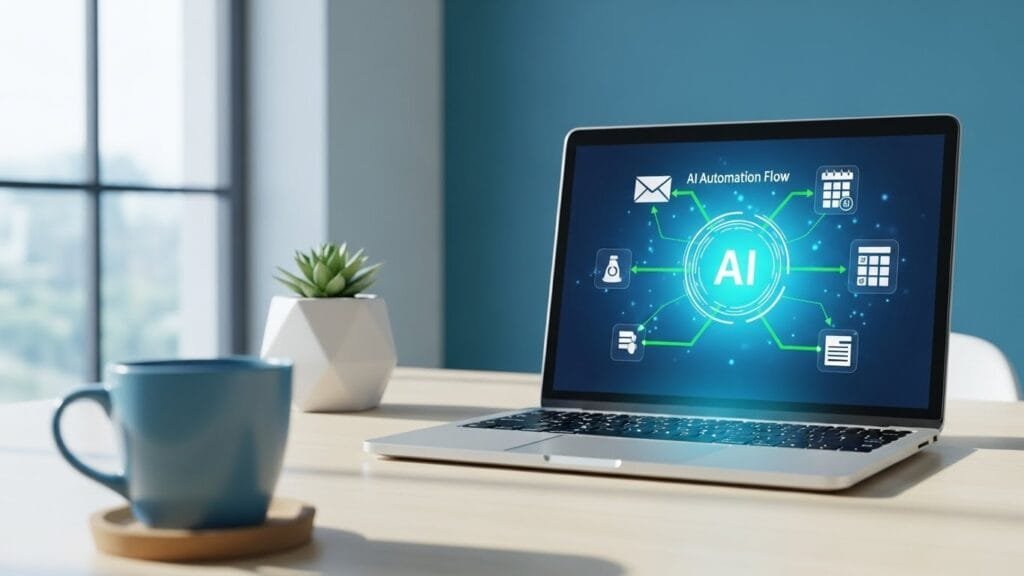
Here’s where things get really interesting. AI is fundamentally changing what our jobs look like day-to-day. Instead of being the person who clicks through twenty different tabs to complete one task, you’re becoming the manager of AI agents that handle those clicks for you.
Think about booking a team meeting. Traditionally, you’d check everyone’s calendar, email the catering company, reserve the conference room, and send invites. Now? You tell an AI agent what you need, and it handles the entire multi-step workflow. You review the final setup and approve it. That’s the shift—from doing every single step to orchestrating the process.
Dr. Andrea Derler, Principal of Research and Value at Visier, puts it perfectly: “AI is transforming the workplace at lightning speed, but humans remain the catalyst for innovation, creativity, and connection.” Her research with early AI adopters shows this technology democratizes access to data and insights across organizations.
Employees who embrace this shift report higher job satisfaction. Nobody misses the soul-crushing drudgery of manual data entry. When you’re freed up to apply your expertise to challenging, rewarding work, your entire experience at work improves.
Real Productivity Gains

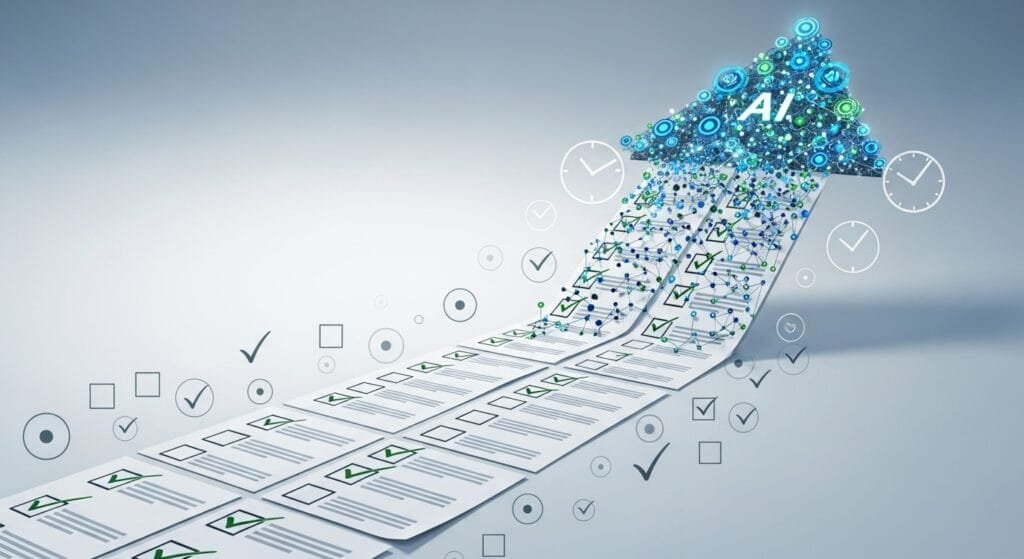
Let’s talk numbers, because the productivity boost from AI isn’t just hype. About two in five U.S. workers are using AI in their jobs right now. Among those who used generative AI in the previous week, they saved an average of 5.4% of their work hours. That might not sound like much at first, but it translates to a 1.1% increase in productivity for the entire workforce.
Here’s what those time savings look like in practice:
- 20.5% of AI users saved four hours or more per week
- 20.1% saved three hours
- 26.4% saved two hours
- 33% saved an hour or less
The daily users see even bigger gains. Among workers who used generative AI every single day, 33.5% said it saved them four or more hours weekly. That’s nearly half a workday freed up for strategic thinking and creative problem-solving.
Research from McKinsey suggests that with generative AI, automation could reduce the hours we work each day by around 30%. The right AI tools handle everything from scheduling to customer support, data entry, and various mundane administrative tasks.
How Work Tasks Are Changing
AI excels at eliminating repetitive work. The tasks that used to drain your energy and time—transcribing calls, entering data into systems, consolidating information—are increasingly handled by intelligent automation.
But it goes beyond simple task automation. AI acts as an efficiency guide that augments your performance in real-time. Tools like Microsoft Copilot can rapidly surface the information you need to complete projects, cutting down the time spent searching for insights. Researchers from Microsoft found that these large language model-powered tools have the potential to increase labor productivity more than any technology in a generation.
The impact is visible across entire workflows:
- Reports that once required hours now take minutes
- Insights surface instantly instead of after days of analysis
- Employees gain mental bandwidth to innovate and solve complex problems
- 97% reduction in manual labor costs for some processes
- 99% reduction in human error rates
Early-adoption organizations are seeing 40%+ faster workflows. Every process gets executed perfectly with a complete audit trail, strengthening compliance and making audit preparation much simpler.
Traditional vs. AI-Enabled Workdays
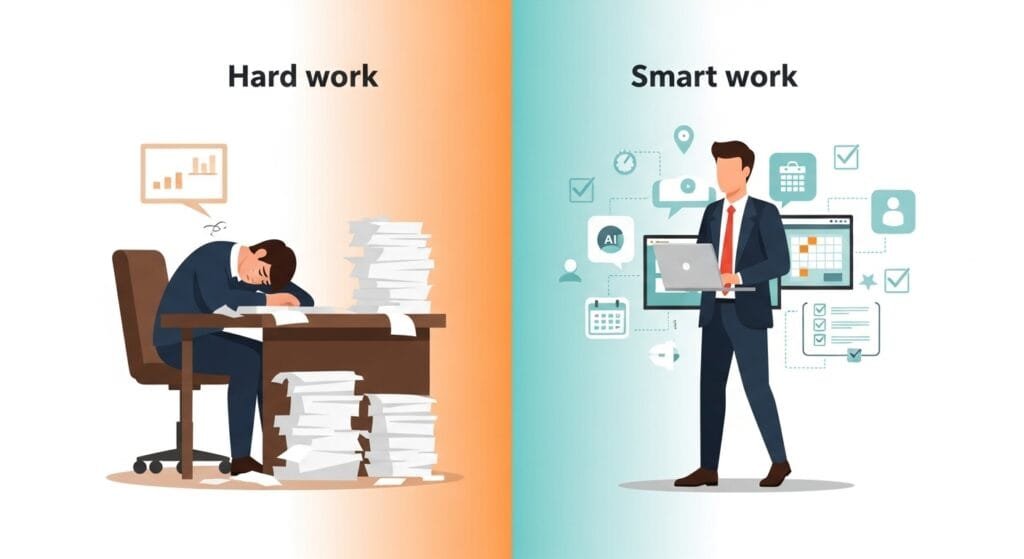
The contrast between old-school and AI-powered work approaches is striking. Here’s how they stack up:
Work Methods Comparison
| Aspect | Traditional Approach | AI-Enhanced Approach |
|---|---|---|
| Schedule Creation | Hours of manual coordination | 30% faster with automated scheduling |
| Decision Accuracy | Based on human judgment alone | Up to 90% prediction accuracy |
| Task Handling | Click through multiple apps/tabs | Single command to AI agent |
| Productivity Gains | Limited by human capacity | 15-30% increase reported |
| Weekly Time Savings | Minimal | Average 5.4% of work hours |
| Error Rates | Prone to human mistakes | Up to 99% reduction in errors |
| Meeting Patterns | Scattered across the week | Clustered mid-week |
| Focus Time | Fragmented throughout days | Protected blocks on Mon/Fri |
Smarter Scheduling and Time Management
AI-powered scheduling tools are revolutionizing how we manage our calendars and workspaces. These systems don’t just book rooms—they predict future staffing needs, optimize resource allocation, and prescribe specific actions to maximize efficiency.
Tools like Microsoft Places use AI to help team members decide when to visit the office and which rooms to book based on their actual needs. The system analyzes how spaces are used throughout the week and adjusts strategies accordingly.
Real-time adjustments are becoming the norm. If priorities shift mid-project, AI can automatically reassign staff to high-priority tasks or suggest schedule swaps to avoid overtime. This responsiveness was nearly impossible with traditional manual scheduling methods.
Organizations using AI for workforce scheduling report:
- 30% reduction in manual scheduling effort
- 25% increase in scheduling accuracy
- 10-20 hours saved per week on routine tasks
- 50% less time spent resolving scheduling conflicts and errors
The system gets smarter over time, learning patterns and preferences to make better recommendations. You’re not fighting your calendar anymore—it’s working with you.
The Four-Day Work Week Possibility
Could AI actually make the four-day work week achievable for most companies? Many industry leaders think so. Zoom’s CEO Eric Yuan and various other analysts have suggested that with AI, the standard 40-hour work week will become a thing of the past.
The logic is straightforward. If AI reduces daily work hours by 30%, as McKinsey research suggests, then the same amount of productive output could theoretically happen in four days instead of five. When AI handles repetitive tasks, employees spend their time on valuable strategic and creative work—making each hour they contribute more impactful.
We’re not quite there yet for most industries. But successful four-day work week trials at various companies show it’s possible when productivity tools are used effectively. AI could be the missing piece that makes it scalable across sectors.
Business leaders can use AI to track engagement and productivity on different days, monitoring the impact of various work schedules on employees. This data-driven approach allows for personalized flexible work scheduling rather than one-size-fits-all policies.
Skills and Adaptation Required
This transformation doesn’t happen automatically—it requires new skills and mindsets. Learning to collaborate with AI on the job is now crucial. Gartner predicts this will become a core competency across industries.
For employees, AI literacy isn’t optional anymore—it’s become the new currency of career success. The good news? You don’t need to become a programmer. You need to learn how to work alongside AI tools, understanding what they can do well and where human judgment is still essential.
Managers face their own evolution. As Harvard Business Review notes, “AI won’t replace managers, but managers who use AI will replace those who don’t.” Leaders must champion ethical AI use, foster trust, and empower teams through data-driven decision-making.
Key areas to develop include:
- Prompt engineering: Learning how to communicate effectively with AI tools
- Critical evaluation: Knowing when to trust AI recommendations and when to dig deeper
- Emotional intelligence: The uniquely human skills that AI can’t replicate
- Continuous learning: Staying current as AI capabilities expand rapidly
Teams that once feared change now thrive on it. The mindset shift is often more important than the technical skills.
What This Means for Job Quality
There’s a common fear that AI will make work more mechanical and less meaningful. The reality appears to be the opposite. When repetitive tasks get automated, work actually becomes more creative and strategic.
Employees report higher job satisfaction when they’re freed from tedious tasks. You get to apply your expertise to the challenging problems you were actually hired to solve. The morale boost from eliminating soul-crushing drudgery shouldn’t be underestimated.
Work becomes more human, not less. You spend less time on repetition and more time on innovation, collaboration, and meaningful problem-solving. The technology amplifies humanity rather than replacing it.
Organizations see benefits beyond individual satisfaction:
- Stronger compliance and control environments
- Faster, data-driven decision-making
- Improved employee retention
- Ability to scale without proportional headcount increases
The most successful implementations happen when companies design AI projects that improve job quality while maintaining trust. It’s about using technology to support people, not sideline them.
Connected Intelligence at Work
Looking ahead to this year and beyond, the workplace won’t evolve through more apps or digital assistants. Instead, we’re moving toward what experts call “Connected Intelligence“—where AI becomes an integrated team member rather than just another tool.
This means knowledge and expertise move instantly to where they’re needed. Digital workers surface insights in context, automate workflows quietly, and keep work moving forward without interrupting human creativity or decision-making. Cultural and geographic barriers start to dissolve when this happens effectively.
Agentic AI will function as a true collaborator. Think of it as having an incredibly efficient assistant who never sleeps, never forgets, and can process vast amounts of information instantly—but still needs your human judgment, creativity, and strategic thinking to guide the work.
The organizations leading this shift embrace open, interoperable ecosystems built on trust. They’re unifying secure connectivity with intuitive, embedded AI to create workplaces where people and digital workers operate as one. This unlocks new levels of agility, creativity, and performance that weren’t possible before.
Success in 2026 and beyond belongs to those who learn, adapt, and lead with purpose. It’s about using both technology and human skills to unleash the best a team can offer.
Moving Forward
The 9-to-5 routine is evolving whether we’re ready or not. The question isn’t whether AI will change how we work—it already is. The real question is how we’ll adapt and make the most of these tools.
Start small if you’re feeling overwhelmed. Pick one repetitive task in your workday and explore whether an AI tool could handle it. Maybe it’s email drafting, meeting summaries, or data consolidation. Test it out and see how it feels.
Stay curious and keep learning. The AI landscape changes quickly, but you don’t need to master everything at once. Focus on tools relevant to your specific role and industry. Join conversations with colleagues about what’s working for them.
Remember that AI is a collaborator, not a replacement. The goal is to free you up for the work that truly requires human creativity, empathy, and strategic thinking. When you approach it that way, the transformation feels less threatening and more empowering.
We’re all navigating this shift together. The companies and individuals who succeed will be those who embrace change while staying grounded in what makes us uniquely human—our ability to innovate, connect, and solve complex problems that machines can’t tackle alone.
My Experience & Insights
When I started diving deep into how AI was actually changing workplace productivity, I wasn’t just reading reports—I was talking to real people managing teams at tech companies, healthcare organizations, and creative agencies. What struck me most was the gap between what the research promised (30% time savings!) and what people actually experienced in their day-to-day work. Some folks were genuinely saving hours every week, while others felt like they were just adding another tool to an already overwhelming tech stack.
That disconnect got me curious. I wanted to understand the practical math behind these productivity gains researchers keep citing. So I built a simple AI Time-Savings Calculator that lets you see how many hours AI could realistically save you weekly based on your specific role and tasks. You plug in your job role, the weekly repetitive tasks you handle, and how many hours you currently spend on them. The calculator then shows you your potential hours saved weekly, your productivity gain percentage, and even your annual time saved.
What I learned from building this tool—and from the dozens of people who’ve tested it—is that the magic isn’t in the AI itself. It’s in honestly identifying which tasks are truly repetitive versus which ones need your human judgment. A marketing manager I spoke with thought she could automate her entire content calendar, but after using the calculator, she realized only about 40% of her tasks were actually repetitive (scheduling posts, resizing images, pulling analytics). The other 60%—crafting messaging, understanding audience sentiment, making strategic pivots—still needed her brain.
The Microsoft research team working on productivity tools found something similar. Their studies showed that the employees seeing the biggest gains weren’t necessarily using AI for everything—they were strategically applying it to high-volume, low-complexity tasks. That freed up mental energy for the complex stuff that actually moves the needle.
Here’s what surprised me most: talking with Dr. Andrea Derler at Visier about their workforce intelligence research, she emphasized that early adopters aren’t just more productive—they’re more satisfied with their work. When you eliminate the tasks that drain you (data entry, scheduling conflicts, searching for that one email from three months ago), you rediscover why you liked your job in the first place. That insight doesn’t show up in productivity percentages, but it’s arguably more important.
If you’re skeptical about whether AI can actually help your specific situation, I get it. That’s exactly why I created the calculator—to move beyond hype and look at your actual workweek. Try mapping out one typical day: what takes up your time, what’s repetitive, and what requires creative thinking. You might be surprised by the pattern that emerges. According to research from Fortune, teams who do this exercise before implementing AI tools see adoption rates three times higher than those who just roll out technology and hope for the best.
AI Time-Savings Calculator
See how many hours AI could save you weekly based on your role and tasks
Frequently Asked Questions
Will AI replace my job or just change how I work?
AI won’t replace most jobs, but it will significantly change what you do daily. The technology excels at handling repetitive, time-consuming tasks like data entry, scheduling, and basic reporting. This frees you up to focus on strategic thinking, creative problem-solving, and relationship-building—things that require human judgment. Research shows that workers using AI spend less time on mundane tasks and more time on meaningful work that actually advances their careers. The key is learning to work alongside AI tools rather than competing against them.
How much time can AI realistically save me each week?
According to recent data from the St. Louis Federal Reserve, workers using generative AI save an average of 5.4% of their work hours. For daily AI users, the gains are even bigger—about 33.5% report saving four or more hours weekly. Your actual time savings depend on how many repetitive tasks fill your workweek. If you spend significant time on email drafting, meeting summaries, data consolidation, or scheduling, you could see substantial gains. The workers seeing the biggest benefits are those who strategically identify their most time-consuming repetitive tasks first.
What skills do I need to learn to work effectively with AI?
You don’t need to become a programmer or data scientist. The most important skill is what experts call “AI literacy”—understanding what AI can and can’t do well. This includes learning prompt engineering (how to communicate clearly with AI tools), critical evaluation (knowing when to trust AI recommendations versus when to dig deeper), and maintaining your emotional intelligence and creativity. Workplace experts emphasize that collaborating with AI on the job is becoming as crucial as basic computer skills were in the 1990s. Start by experimenting with one AI tool relevant to your role and gradually expand from there.
Is the four-day work week really possible with AI?
It’s possible, but we’re not there yet for most industries. McKinsey research suggests AI could reduce daily work hours by around 30%, which theoretically makes a four-day workweek achievable while maintaining the same output. Some companies are already experimenting with this model successfully. However, the transition requires more than just technology—it needs cultural shifts, management buy-in, and careful implementation. Organizations that track engagement and productivity data across different work schedules are better positioned to make informed decisions about compressed workweeks.
How is AI changing when and how we schedule meetings?
AI-powered scheduling tools are creating more intentional work patterns. Instead of meetings scattering randomly throughout the week, teams using AI are clustering meetings toward the middle of the week (Tuesday through Thursday). This leaves Mondays and Fridays open for deep, focused work without constant interruptions. The technology analyzes team calendars, predicts optimal meeting times based on past patterns, and even suggests which meetings could be emails instead. Organizations report 30% faster scheduling and 50% less time resolving conflicts. The result is less calendar chaos and more protected time for concentration.
What’s the difference between AI tools replacing work versus augmenting work?
Replacement means AI does the entire job independently, while augmentation means AI assists you in doing your job better and faster. Most workplace AI falls into the augmentation category. For example, AI doesn’t write your entire business proposal—it helps you draft sections faster, suggests improvements, and catches errors you might miss. It doesn’t make strategic decisions for your company—it surfaces relevant data and insights so you can make better-informed decisions. Research from Visier shows that successful AI implementation focuses on augmenting human capabilities rather than replacing them. The technology handles the repetitive groundwork so you can focus on applying your expertise, creativity, and judgment to complex challenges.
🔒 Always double-check security and privacy implications.
⚙️ Use tools, software, and methods at your own discretion.