
🔒 Always double-check security and privacy implications.
⚙️ Use tools, software, and methods at your own discretion.
If you’re reading this, chances are you’ve caught yourself scrolling through your phone without even remembering why you picked it up. Digital Mindfulness & Focus Habits have become essential tools for navigating our hyperconnected world in 2026, where the average person checks their phone a staggering 144 times daily—roughly every 12 minutes. I’ve been there too, and the good news is that small, intentional changes can help us take back control of our attention and mental energy.
Our brains weren’t designed for the constant barrage of notifications, emails, and social media updates we face today. Research shows that employees with stable digital connectivity are 59% more productive than those experiencing constant interruptions. But here’s the thing—technology isn’t the enemy. It’s how we use it that matters. Let’s explore practical habits that blend ancient mindfulness wisdom with modern neuroscience to help you focus better and feel more present.
- Why Your Attention Span Needs a Rescue Plan
- The Science Behind Mindfulness and Focus
- Digital Mindfulness & Focus Habits That Actually Work
- Comparing Digital Habits: Mindful vs. Mindless Usage
- Digital Habit Comparison
- The Real-World Benefits You’ll Notice
- Common Challenges (and How to Overcome Them)
- Creating Your Personal Digital Mindfulness Plan
- The Bigger Picture: Why This Matters Now
- Moving Forward With Intention
- My Experience & Insights
- Digital Distraction Score Calculator
- Frequently Asked Questions
Why Your Attention Span Needs a Rescue Plan
Ever feel like you can’t focus on anything for more than a few minutes? You’re not alone. Dr. Gloria Mark, a Chancellor’s Professor at the University of California, Irvine’s Donald Bren School of Information and Computer Sciences, has spent years studying how digital media affects our lives. Her research found that our average attention span dropped from about 2.5 minutes in 2004 to just 44-50 seconds by recent measurements. That’s less time than it takes to read this paragraph.
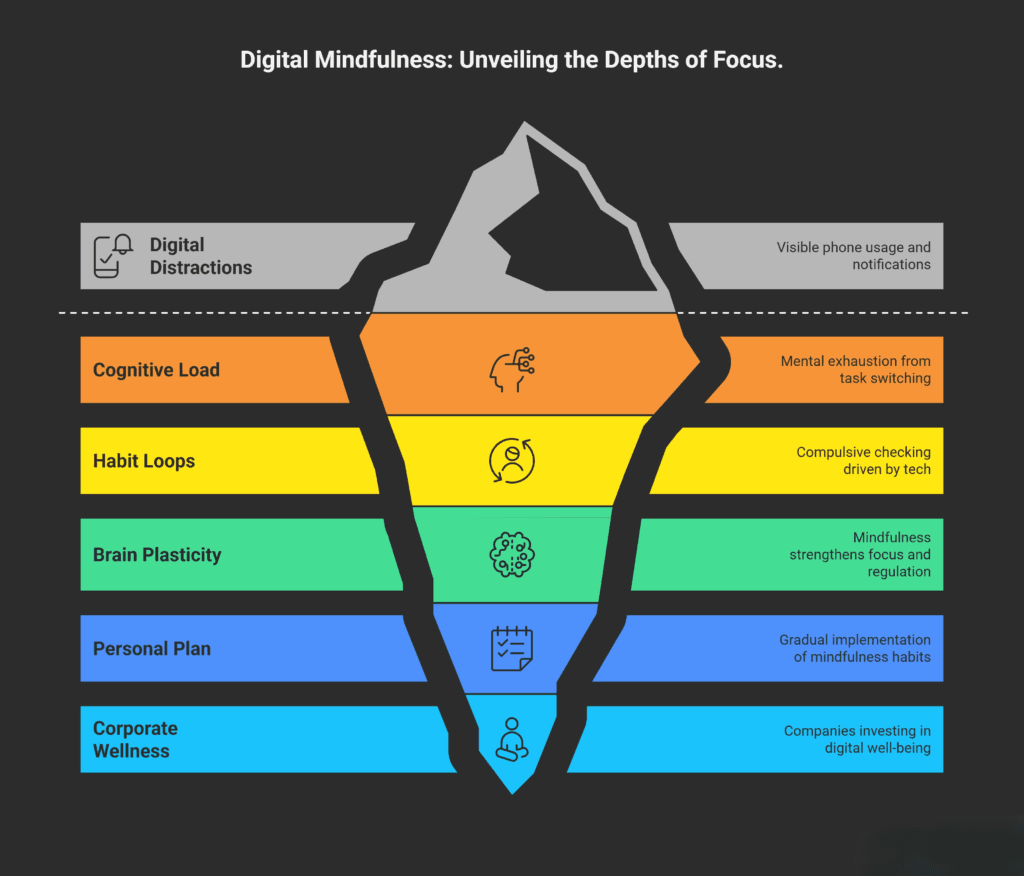
The problem goes deeper than just distraction. When we’re constantly switching between tasks and apps, our brains experience what researchers call “cognitive load”—basically, mental exhaustion from juggling too much at once. A study found that digital distractions in meetings significantly increased cognitive load and made meetings take 30% longer (120 minutes versus 90 minutes) to reach the same decisions.
About 67% of smartphone users check their phones even when they’re not ringing or vibrating. This compulsive checking isn’t a character flaw—it’s a habit loop that tech companies have spent billions of dollars perfecting. The first step to breaking free is recognizing these patterns in ourselves.
The Science Behind Mindfulness and Focus

So what’s the antidote? Turns out, mindfulness meditation isn’t just feel-good advice—it’s backed by solid neuroscience. Andy Jeesu Kim, a postdoctoral scholar at the USC Leonard Davis School of Gerontology working with Dr. Mara Mather, led a groundbreaking 2025 study that used eye-tracking technology to measure attention. His team found that just 30 days of guided mindfulness meditation significantly improved how quickly and accurately people directed their focus, regardless of age.
Here’s what actually happens in your brain when you practice mindfulness regularly:
- Strengthened prefrontal cortex: This area manages focus and decision-making, helping you resist impulses to check your phone
- Calmed amygdala: The brain’s fear and stress center becomes less reactive to digital triggers
- Improved functional connectivity: Research from 2025 shows increased connections between brain networks responsible for attention control
- Enhanced grey matter: Brain regions tied to decision-making and emotional control actually grow denser with consistent practice
A 2016 study found that participants who practiced just three 10-minute sessions of breath-focused meditation showed significant improvements in attention compared to those who browsed the internet. Even more interesting? Heavy media multitaskers got the biggest benefits, temporarily reversing their attention struggles.
Digital Mindfulness & Focus Habits That Actually Work
Let me share seven practical habits you can start using today. These aren’t about becoming a digital hermit—they’re about using technology intentionally instead of letting it use you.
1. The Morning Phone Delay
Instead of reaching for your phone the moment you wake up, wait at least 30 minutes. Use that time for a short meditation, light stretching, or just enjoying your coffee without distractions. This simple habit sets a calm tone for your day rather than immediately flooding your brain with information and demands.
2. Notification Housecleaning
Go through your apps and silence notifications for everything except truly urgent contacts. Most of us don’t need to know instantly about every like, comment, or promotional email. Research shows that consistent mindfulness practice can reduce reflexive phone usage by up to 60% in just eight weeks.
3. The Impulse Pause Technique
Before unlocking your phone, take three deep breaths and ask yourself, “Why am I picking this up right now?” This tiny pause activates your prefrontal cortex, giving you a chance to make a conscious choice instead of acting on autopilot. It sounds simple, but it’s surprisingly effective at breaking the compulsive checking cycle.
4. Scheduled Digital Breaks
Set specific times for checking email and social media rather than staying constantly connected. Try the “batch processing” approach—check your messages at 10 AM, 2 PM, and 5 PM instead of every few minutes. Your brain will thank you for the focused work time in between.
5. Tech-Free Zones and Times
Designate certain areas of your home (like the bedroom or dining table) or times of day (like the first hour after getting home) as phone-free. This creates natural boundaries that help you be more present with loved ones and activities you enjoy.
6. Mindful Screen Time Tracking
Use your phone’s built-in screen time features to track your usage without judgment. Just becoming aware of your patterns is the first step to changing them. You might be surprised to discover you’re spending three hours a day on social media when you thought it was only 30 minutes.
7. The 8-10 Minute Meditation Habit
Studies show that just 8 to 10 minutes of breath-focused meditation can significantly enhance sustained attention. Apps like Headspace and Calm now offer AI-driven habit builders that analyze your sleep data to suggest optimal meditation times. Even short sessions make a real difference when practiced consistently.
Comparing Digital Habits: Mindful vs. Mindless Usage
Let’s look at how mindful and mindless digital habits differ in everyday scenarios:
Digital Habit Comparison
Select a scenario to explore mindful alternatives
| Scenario | Mindless Digital Habit | Mindful Digital Habit |
|---|---|---|
| Waking Up | Check phone immediately, scroll social media in bed | Wait 30 minutes, start with breath work or meditation |
| Work Meetings | Phone on table, checking notifications during discussion | Phone silenced away from view, full attention on speakers |
| Email Management | Check constantly throughout day, respond immediately | Batch check 2-3 times daily at scheduled intervals |
| Evening Wind-Down | Screen time until bedtime, TV while scrolling phone | Digital sunset 1 hour before bed, read or journal instead |
| Social Time | Phone on table, partial attention to conversation | Phone put away, eye contact and active listening |
| Boredom Response | Automatically reach for phone to fill every quiet moment | Notice the urge, take three breaths, choose intentionally |
Selected Scenario
None selected yet
Mindless Habit
Select a scenario above to see details
Mindful Alternative
Select a scenario above to see details
The difference isn’t about using less technology—it’s about using it more purposefully. As Cal Newport, a computer science professor at Georgetown University and author of “Digital Minimalism,” points out, we need to be more intentional about how we deploy digital tools in ways that support rather than undermine what we care about.
The Real-World Benefits You’ll Notice
When you start practicing these digital mindfulness habits, the changes show up in surprising ways. A 2025 review on digital detox found several key benefits:
- Improved attention and focus: You’ll find it easier to stick with tasks and think deeply
- Reduced stress and anxiety: Less exposure to constant digital demands means lower cortisol levels
- Better sleep quality: Cutting screen time before bed helps your brain wind down naturally
- Enhanced self-reflection: Quiet moments without digital stimulation give you space to think and process emotions
- Stronger social connections: Being fully present makes conversations more meaningful
Workers report feeling more productive when they can work without constant digital interruptions. In fact, employees at Buffer found that 91% felt more productive after the company introduced a 4-day work week focused on mental health and rest. While you might not control your work schedule, you can control how you manage your own digital boundaries.
Common Challenges (and How to Overcome Them)
Let’s be real—changing digital habits isn’t easy. Here are some hurdles you might face and practical ways to work through them:
“My job requires me to be constantly available.” Start small by explaining to colleagues that you’ll batch-check messages at specific times for deeper focus. Most “urgent” matters can actually wait an hour or two. Set up auto-responses that share your communication schedule.
“I get FOMO when I’m not scrolling social media.” Remember that social media shows highlight reels, not reality. Try a one-week experiment where you check social platforms just once daily. You’ll likely discover you didn’t miss anything important, and you’ll have more time for activities that genuinely fulfill you.
“My mind wanders during meditation.” That’s completely normal and expected. The practice isn’t about achieving a blank mind—it’s about noticing when your attention drifts and gently bringing it back. Every time you notice and return, you’re strengthening your focus muscle.
“I feel anxious without my phone nearby.” This is real, and it has a name: nomophobia (no-mobile-phone phobia). About 44% of adults experience anxiety when they don’t have their phones. Start with baby steps. Leave your phone in another room for just 15 minutes while you eat lunch. Gradually extend that time as you build confidence that you’re not missing anything critical.
Creating Your Personal Digital Mindfulness Plan

Ready to build your own practice? Here’s a simple framework to get started:
Week 1: Awareness
Just observe your current habits without trying to change them. Track when and why you reach for your phone. Notice how different apps make you feel. This baseline awareness is crucial.
Week 2: Small Changes
Pick one habit from the list above that feels doable. Maybe it’s the morning phone delay or turning off non-essential notifications. Stick with just this one change for the entire week.
Week 3: Add Meditation
Start with just 5 minutes of breath-focused meditation daily. Set a recurring calendar reminder. Apps like Insight Timer offer over 130,000 free guided sessions to help you build consistency.
Week 4: Reflect and Adjust
What’s working? What feels too hard right now? Adjust your approach based on what you’ve learned about yourself. The goal isn’t perfection—it’s progress.
The Bigger Picture: Why This Matters Now
We’re at a turning point in our relationship with technology. Corporate wellness spending is at an all-time high in 2026, yet employee health outcomes continue to struggle. Companies are recognizing that digital wellness programs focusing on mental health support and flexible work culture are essential for productivity.
But you don’t have to wait for your employer to create a program. You can start right now by implementing even one or two of these habits. The research is clear: consistent mindfulness practice literally reshapes your brain, strengthening the networks that support attention, emotional regulation, and decision-making.
Dr. Gloria Mark’s work shows that our psychology is just as important as technology in our increasing distractibility. That’s actually good news, because it means we have more control than we think. We’re not helpless victims of our devices—we just need better strategies for managing them.
Moving Forward With Intention
As we navigate the rest of 2026 and beyond, the ability to focus deeply and be present will become increasingly valuable. While half of employers are enforcing strict measures to minimize digital distractions in the workplace, the most powerful changes happen when we choose them for ourselves.
Start where you are. Pick one habit that resonates with you and commit to it for just two weeks. Notice what shifts. Maybe you’ll sleep better, or feel less anxious, or find yourself more engaged in conversations with friends. These small wins build momentum.
The beauty of digital mindfulness isn’t that it turns you into a meditation guru or requires you to give up technology. It simply helps you use your devices as tools that serve your goals, rather than letting them hijack your attention and energy. Your brain has incredible plasticity—the ability to change and adapt at any age, as Kim’s research on mindfulness benefits across age groups demonstrates.
You’ve got this. And honestly? Your future focused, present, less-stressed self will thank you for starting today.
My Experience & Insights
When I first started digging into digital focus and mindfulness, I kept seeing the same pattern: people weren’t just “bad at focusing,” they were overwhelmed by tiny, constant pulls on their attention. It wasn’t one big distraction; it was dozens of small ones stacked together. While reviewing research on attention and digital behavior, I noticed how often phone checks, app hopping, and unfocused meetings showed up as quiet culprits behind stress and mental fatigue.
As I went through studies on attention span and multitasking, I kept thinking, “This is useful, but how does an everyday person see their own distraction level in a simple way?” Most of the science talks about averages and group behavior, but you and I live this at a very personal level: how many times you grab your phone during a task, how often you drift in meetings, how scattered you feel by the end of the day.
That’s what inspired me to create a small tool: a Digital Distraction Score Calculator.
I wanted something practical that does three things for you:
- Turns your habits into a clear distraction score (1–100)
- Looks at how often you check your phone, which apps dominate your time, and how focused you stay in meetings
- Then gives you three tailored mindfulness habits right away, based on your score
When I tested early versions of the calculator with a few users, the reactions were interesting. A lot of people thought they were “kind of distracted,” but seeing a number—like 72 out of 100 for distraction—felt like a wake-up call. It turned a vague feeling into something concrete they could work on.
One person who tried it realized they were checking their phone more than 100 times a day, mostly during “in-between” moments: waiting for a file to load, walking between rooms, even during short pauses in meetings. Once they saw that pattern, they picked one of the suggested habits—taking three deep breaths before every phone unlock—and told me within a week they felt less jittery and more in control of their time.
For me, the most eye-opening part has been how small changes add up. When I built the calculator’s recommendation logic, I focused on simple, low-friction habits: a brief morning phone delay, a single tech-free zone, or one 8–10 minute mindfulness session per day. These are the kinds of habits that fit into real life, even on days when you’re tired or busy.
I also paid a lot of attention to not making the tool judgmental. The goal isn’t to shame anyone for scrolling or checking messages. It’s to give you a mirror that reflects your digital habits and then offer gentle, science-informed nudges toward more mindful use—habits that align with what researchers and experts are finding about focus, stress, and attention in our always-on world.
If you decide to use a tool like this, I’d encourage you to treat it as a starting point, not a verdict. Your score is just a snapshot. The real power comes from watching that number shift over time as you experiment with new habits, find what works for you, and build a digital life that feels calmer, more intentional, and a lot less noisy.
Digital Distraction Score Calculator
See how your digital habits compare to mindfulness benchmarks
Your Digital Mindfulness Profile
Calculating…
Your score is being calculated based on mindfulness research
Recommended Mindfulness Habits
Your Phone Checks
—
vs. average of 144/day
Attention Span Impact
—
based on habit patterns
Weekly Focus Recovery
—
potential with mindfulness
Frequently Asked Questions
1. How long does it take to see results from digital mindfulness habits?
Most people notice improvements within 1-2 weeks of consistent practice, like feeling less anxious or more present during conversations. Research shows that just 8-10 minutes of daily breath-focused meditation can boost sustained attention significantly after a few sessions, with bigger gains around the 30-day mark from studies like the USC mindfulness research we discussed.
2. Can I practice digital mindfulness if I need my phone for work?
Absolutely—it’s about smarter use, not quitting tech. Try batching email checks (like 10 AM, 2 PM, 5 PM) and silencing non-urgent notifications during focus blocks. Workers using these strategies often report 59% higher productivity when they minimize constant interruptions, according to recent connectivity studies.
3. What if my mind wanders during meditation—am I doing it wrong?
Not at all! Mind wandering is normal and expected, even for experts. The practice is noticing the drift and gently returning your focus—like a mental bicep curl for attention. Dr. Gloria Mark’s research on attention spans shows this “noticing and redirecting” builds resilience against digital distractions over time.
4. How do I calculate my own Digital Distraction Score?
Use the Digital Distraction Score Calculator I created—it takes about 2 minutes. Input your daily phone checks (average is 144), top 3 time-sucking apps, and meeting focus level (1-10). You’ll get a 1-100 score plus 3 personalized habits, like a “3-breath phone pause” if notifications dominate your day.
5. Will turning off notifications make me miss important messages?
Rarely—most “urgent” items can wait 30-60 minutes. Set VIP exceptions for family or key colleagues, and use auto-replies like “I’ll respond during my next check at 2 PM.” Studies on compulsive checking show 67% of phone grabs happen without real alerts anyway, so you’ll gain focus without real risk.
6. What’s the best app for beginners starting mindfulness?
Start with free options like Insight Timer (130,000+ guided sessions) or The Mindfulness App’s short focus meditations. Pair it with your phone’s built-in screen time tracker for awareness. Aim for 5 minutes daily at first—consistency beats perfection, and apps like these make it easy to build the habit alongside your digital boundaries.
🔒 Always double-check security and privacy implications.
⚙️ Use tools, software, and methods at your own discretion.