

🔒 Always double-check security and privacy implications.
⚙️ Use tools, software, and methods at your own discretion.
Have you ever wondered how to stay focused in the AI age when every app on your phone seems smarter than you are? You sit down to send one email, and suddenly, it’s 20 minutes later. You’re deep in a social media scroll, watching a video recommended by an algorithm that knows exactly what you like. It feels like an accident, but it’s not.
We are living through a massive shift. A few years ago, we just had to worry about loud coworkers or a buzzing phone. Now, we are up against Artificial Intelligence (AI). These systems are designed to capture our attention and hold it. They are learning from our clicks, our pauses, and even our hesitation. It can feel like an unfair fight.
But here is the good news: you can win. You don’t need to throw away your smartphone or move to a cabin in the woods. You just need a new set of skills. We call this “Digital Mindfulness.” It is about taking back control. In this post, I will walk you through exactly how to do that, with help from some of the world’s top experts.
The New Enemy of Focus: The “Attention Economy”
Before we fix the problem, we have to understand it. Why is it so hard to pay attention right now?
Research shows our focus is shrinking. Gloria Mark, a Chancellor’s Professor at the University of California, Irvine, has studied this for decades. Her team found a startling statistic. In 2004, the average person focused on a screen for about 2.5 minutes before switching tasks. By recent years, that number had dropped to just 47 seconds.
Think about that. Forty-seven seconds. That is barely enough time to read a paragraph.
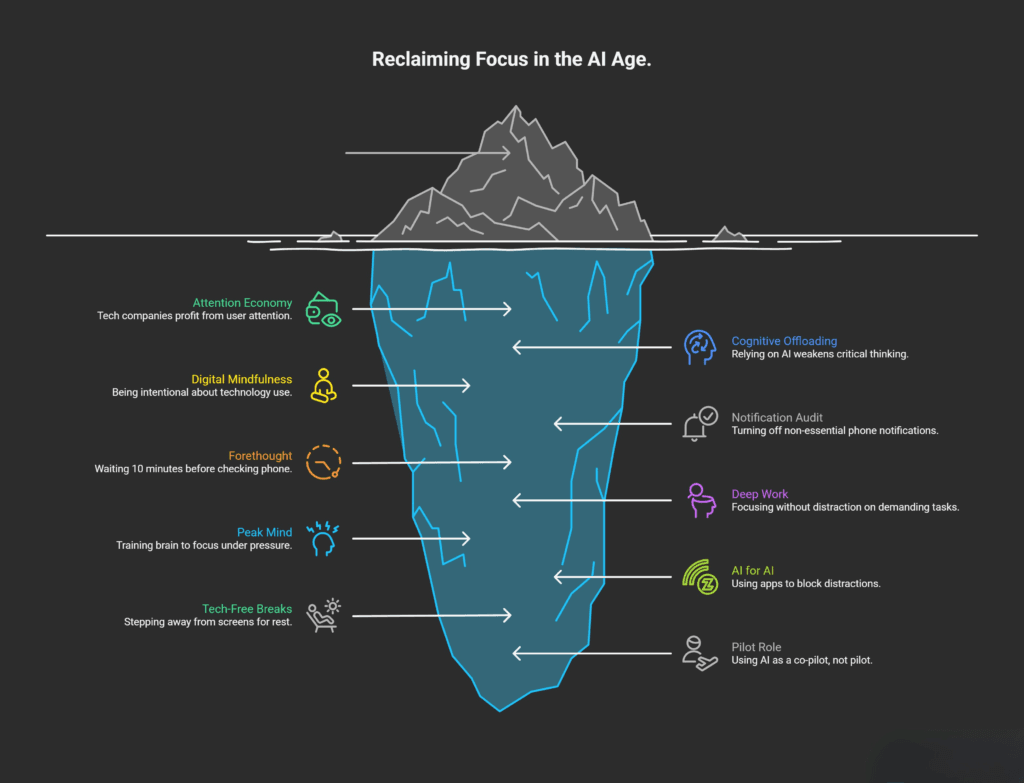
This isn’t just because we are lazy. It is because of the “Attention Economy.” Tech companies make money when we look at their apps. The more time we spend scrolling, the more ads they show us. Now, with AI, these apps are better than ever at hooking us. They predict what we want to see before we even know we want it.
Tristan Harris, a former design ethicist at Google and co-founder of the Center for Humane Technology, warns us about this. He explains that we aren’t just fighting against a screen; we are fighting against a supercomputer aimed directly at our brains.
Cognitive Offloading: When AI Thinks for Us
There is another trap, too. It is called “cognitive offloading.” This happens when we let technology do the thinking for us.
Imagine you need to write a difficult email or solve a problem. It is tempting to just ask an AI chatbot to do it. While that saves time, it can make our own focus muscles weak. A recent article in The Oxford Student highlighted how AI is eroding our critical thinking by encouraging us to offload our mental work. If we stop using our brains for hard tasks, we lose the ability to focus on them.
Digital Mindfulness: More Than Just Quitting

So, what is the solution? It is not about quitting technology. It is about Digital Mindfulness.
Digital mindfulness doesn’t mean meditating on a mountain. It means being intentional. It means you decide when to use your phone, rather than letting your phone decide for you.
Nir Eyal, the author of Indistractable, says that distraction starts from within. We check our phones to escape a bad feeling, like boredom or anxiety. If we can understand that trigger, we can stop the habit.
Here is a simple way to look at the difference between the old distractions we used to face and the new ones powered by AI.
Table 1: Old Distractions vs. AI-Powered Distractions
Distractions Comparison
| Feature | Old Distractions (The Past) | AI-Powered Distractions (The Present) |
|---|---|---|
| Source | Past A loud TV, a phone call, a noisy neighbor. | Present Algorithms, chatbots, infinite scroll feeds. |
| Timing | Random (happens whenever). | Personalized (happens exactly when you are bored). |
| Goal | None (usually accidental). | Engagement (designed to keep you hooked). |
| Difficulty to Ignore | Moderate. You can walk away. | High. It plays on your psychology and dopamine. |
| Impact on Brain | Temporary annoyance. | Rewires habits and weakens deep focus. |
As you can see, the game has changed. We need new rules to play it.
7 Steps to Reclaim Your Focus
If you want to know how to stay focused in the AI age, you need a plan. Here are seven practical steps you can take today.
1. Perform a “Notification Audit”
Your phone is likely buzzing all day. Each buzz breaks your concentration. Even if you don’t look at it, your brain wonders, “Who was that?”
The Fix: Go into your settings right now. Turn off notifications for everything except the essentials.
- Keep: Text messages (maybe), phone calls, calendar reminders.
- Cut: Social media, news alerts, game updates, shopping apps.
You don’t need to know that a shoe store is having a sale while you are working. You can check that later.
2. Practice “Forethought” (The 10-Minute Rule)
Nir Eyal suggests a great trick for handling the urge to check your phone. He calls it “surfing the urge.”
When you feel the itch to check Instagram or ask an AI bot a question you could answer yourself, wait. Tell yourself, “I can do that, but not right now. I will wait 10 minutes.”
Usually, the urge will pass. You are training your brain to pause. This pause is where you regain control.
3. Rediscover “Deep Work”
Cal Newport, a computer science professor at Georgetown University, coined the term “Deep Work.” This is the ability to focus without distraction on a cognitively demanding task.
In the AI age, this is a superpower. AI can do the easy, shallow work (like writing basic emails). But humans are still needed for deep, creative thinking.
How to do it:
- Schedule a block of time (start with 30 minutes).
- Put your phone in another room.
- Close all unnecessary browser tabs.
- Focus on one single task.
It will feel hard at first. Your brain will beg for a distraction. That is normal. Keep going.
4. Train Your “Peak Mind”
Did you know you can train your brain like a muscle? Dr. Amishi Jha, a professor of psychology at the University of Miami, studies the science of attention. She works with soldiers and athletes to help them focus under high pressure.
She recommends a “mindfulness push-up.” Here is how to do it:
- Sit comfortably and close your eyes.
- Focus on the sensation of your breath.
- When your mind wanders (and it will), notice it.
- Gently bring your focus back to your breath.
Every time you bring your focus back, that is one “push-up” for your brain. Dr. Jha found that doing this for just 12 minutes a day can protect your attention from degrading, even during high stress.
5. Use AI to Fight AI
This might sound funny, but you can use technology to protect yourself from technology.
There are apps designed to block distractions. They act like a shield against the algorithms.
- Freedom: Blocks the internet or specific apps for a set time.
- Opal: Limits access to distracting apps on your phone.
- One Sec: This app forces you to take a deep breath before opening social media. It creates a small barrier that breaks the habit loop.
If you are wondering how to stay focused in the AI age, fighting fire with fire is a smart move.
6. Take “Tech-Free” Breaks
Gloria Mark’s research suggests that we need to replenish our cognitive resources. But scrolling through TikTok on your break doesn’t help. It actually drains you more.
Your brain needs a real break. This means stepping away from screens entirely.
- Look out a window.
- Walk around the block.
- Fold some laundry.
- Doodle on a piece of paper.
These “boring” moments are when your brain rests and resets.
7. Be the Pilot, Not the Passenger
Finally, remember your role. AI tools like ChatGPT are amazing co-pilots. They can help us organize, plan, and create. But they should not be flying the plane.
When you use AI, have a clear goal.
- Bad: Opening a chatbot and asking, “What should I do today?”
- Good: Writing a list of tasks yourself, then asking the chatbot, “Please format this list into a table.”
Keep the “executive function” (the decision-making part of your brain) for yourself. Larry Rosen, an expert in the psychology of technology, warns that multitasking and constant tech use can overload this part of our brain. By staying in the driver’s seat, you keep your mind sharp.
The Future of Focus

The technology around us is going to keep getting faster and smarter. The algorithms will get better at predicting what keeps us scrolling. If we aren’t careful, we could drift into a life where we are always reacting and never really creating.
But it doesn’t have to be that way.
We have a choice. We can let the digital current sweep us away, or we can learn to swim. By understanding how to stay focused in the AI age, you are protecting something precious: your own life experience.
Focus is more than just getting work done. Focus is how we connect with our friends. It is how we enjoy a sunset. It is how we learn a new hobby. When we pay attention, we are truly alive.
So, try one of these tips today. Turn off a notification. Do a few “brain push-ups.” Leave your phone in the other room for an hour. You might be surprised by how much lighter and clearer you feel.
The AI age is here, but your mind still belongs to you. Let’s keep it that way.
My Experience & Insights: Why I Built the “Focus Health Score”
While researching this post, I spent a lot of time reading through Gloria Mark’s work on attention spans. One specific finding really hit home for me: it takes an average of 23 minutes and 15 seconds to get back on track after being interrupted.
I realized I was interrupting myself constantly. I’d check an email, lose 23 minutes of deep focus, and then wonder why I felt exhausted by 2 PM. I wasn’t just “multitasking”—I was actively breaking my own brain’s flow.
I wanted to stop guessing how bad my habits were and actually measure them. That is why I built a simple, free tool for my readers called the Focus Health Score.
It is designed to give you a reality check without the judgment.
- How it works: You answer 8 quick questions about your daily digital habits (it takes about 60 seconds).
- What you get: An instant Focus Score (from 1-100) that tells you exactly how “distraction-proof” your current lifestyle is.
- The best part: You also get a tailored 3-step improvement plan based on your specific weak spots—whether that’s morning scrolling or notification overload.
I created this because I believe you can’t fix what you don’t measure. Give it a try below and see where you stand.
Focus Health Score Calculator
Discover your personal focus score and get tailored recommendations in 60 seconds
Your Focus Health Score
Your Personalized Focus Plan
Frequently Asked Questions
Is AI really destroying our attention span, or is that just a myth?
It is not a myth, but "destroying" might be too strong a word. Think of it like junk food. AI algorithms are designed to be "hyper-palatable" to our brains, making regular tasks feel boring by comparison. Research shows our average attention span on screens has dropped significantly (to about 47 seconds), largely because these tools are trained to interrupt us constantly.
Can I use AI tools like ChatGPT without losing my ability to think deeply?
Absolutely. The key is "cognitive offloading." If you let AI do the thinking (like writing an entire essay for you), your brain muscles will get weak. But if you use AI to brainstorm ideas or organize your rough notes, you stay in the driver's seat. Use it as a junior assistant, not the CEO of your mind.
What are the best apps to help me stay focused in the AI age?
Ironically, technology can help fight technology. Apps like Freedom (to block the internet), Opal (to limit social media access), and One Sec (which forces a deep breath before opening apps) are excellent. They add a layer of friction that stops you from doomscrolling on autopilot.
How do I practice digital mindfulness if my job requires me to be online all day?
You don't need to disconnect completely. Try "batching" your notifications. Instead of keeping email open all day, check it only at 9 AM, 1 PM, and 4 PM. Communicate this to your team. Most emergencies aren't actually emergencies, and you will produce better work when you aren't constantly distracted.
How can I protect my children’s focus from AI-driven algorithms?
Start with "Tech-Free Zones" in the house, like the dinner table or bedrooms. More importantly, talk to them about how the algorithms work. Explain that the "Next Video" button is designed to keep them watching, not to make them happy. When kids understand they are being manipulated by a bot, they often want to fight back.
Do I have to quit social media entirely to regain my focus?
Not at all. Digital mindfulness isn't about deleting every app; it's about being intentional. Instead of scrolling whenever you have a free moment, schedule 15 minutes a day to enjoy social media guilt-free. The goal is to make sure you are choosing when to look, rather than letting a notification choose for you.
🔒 Always double-check security and privacy implications.
⚙️ Use tools, software, and methods at your own discretion.