

🔒 Always double-check security and privacy implications.
⚙️ Use tools, software, and methods at your own discretion.
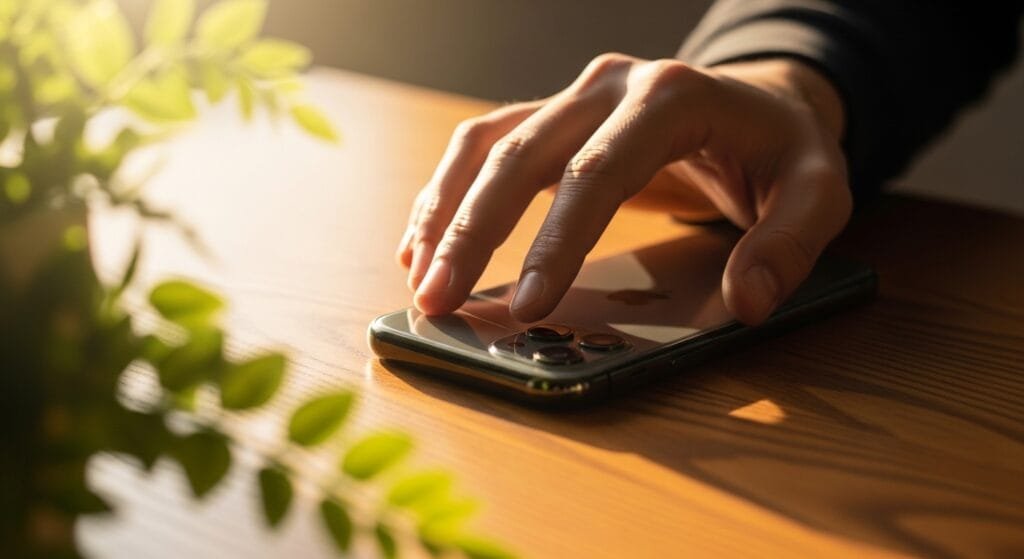
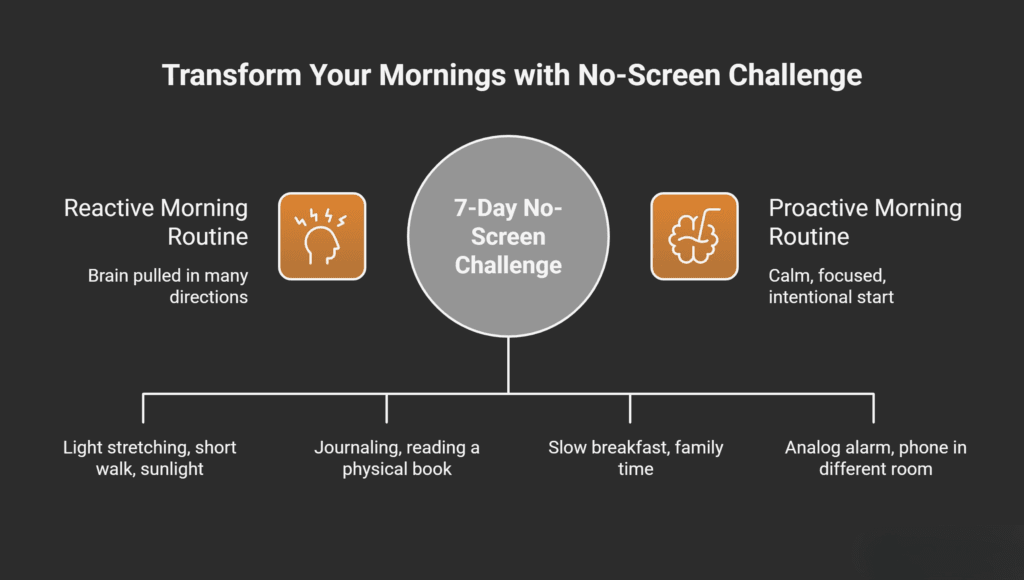
The no screen morning challenge might be exactly what you need if you wake up feeling tired before your feet even hit the floor. We’ve all been there. You reach for your phone to kill the alarm, and twenty minutes later, you’re still scrolling through emails or news. It feels like your brain is being pulled in ten different directions before you’ve even had a sip of coffee. I decided to change that, and I want to share how you can do it, too.
Why We Are Glued to Our Grids

In 2026, our phones are basically extra limbs. We use them for everything. But starting your day with a screen puts your brain into a “reactive” mode. Instead of deciding how you want your day to go, you are reacting to other people’s problems, polished photos, or stressful headlines.
Dr. Anna Lembke, a professor at Stanford University and author of Dopamine Nation, explains that our devices provide a constant stream of digital dopamine. When we check our phones first thing, we’re hunting for a quick reward. This can make the rest of our day feel dull or boring by comparison. By stepping away, we give our brains a chance to reset.
Your 7-Day Game Plan
Taking on a no screen morning challenge doesn’t mean you have to move to a cabin in the woods. It just means setting boundaries. Here is a simple breakdown of how to spend your first hour without a phone.
Day 1–2: The Physical Reset
On the first two days, focus on your body. Instead of checking TikTok, try some light stretching or a short walk. Dr. Andrew Huberman, a neuroscientist at Stanford Medicine, suggests that getting natural sunlight in your eyes shortly after waking is the best thing you can do for your sleep and energy. It tells your brain it’s time to be awake!
Day 3–4: The Mental Clear-Out

By day three, you might feel an “itch” to check your messages. Resist it! Use this time to journal or read a physical book. Just ten minutes of quiet thought can lower your stress levels significantly.
Day 5–7: Building the Habit

Now that you’ve survived most of the week, focus on a “slow” breakfast. Actually taste your food. Talk to your family or your pets. You’ll notice that you feel more “present” and less rushed.
Screen vs. No-Screen: What’s the Difference?
It’s easy to say “screens are bad,” but seeing the data helps. Here is a quick look at how your morning changes when you ditch the tech.
Morning Routine Comparison
| Feature | The “Scroll” Morning | The Screen-Free Morning |
|---|---|---|
| Stress Levels | High (Cortisol spikes from news/work) | Low (Calm, steady start) |
| Focus | Fragmented (Attention jumps around) | Deep (Focused on one task at a time) |
| Mood | Reactive (Based on what you see) | Proactive (Based on your intentions) |
| Time Awareness | “Time Blindness” (Minutes disappear) | Intentional (You know where time goes) |
Making It Stick
The hardest part is the first five minutes. If your phone is your alarm, you’re already in a “danger zone.” I highly recommend buying a cheap, old-fashioned analog alarm clock. If you keep your phone in a different room, you won’t be tempted to grab it the moment you blink.
Nir Eyal, a behavioral design expert and author of Indistractable, notes that most of our tech use is a response to discomfort. We scroll because we are bored, anxious, or overwhelmed. When we acknowledge that feeling, we can choose a better way to handle it—like taking a deep breath instead of clicking an app.
The Big Benefits
What happens after seven days? Most people report feeling “lighter.” You aren’t carrying the weight of the world’s problems at 7:00 AM. You might also find that you have more time than you thought. Those “missing” thirty minutes spent on social media are now yours to use for exercise, a hobby, or just a peaceful cup of tea.
Final Thoughts
The world won’t end if you wait until 8:00 AM to check your email. Your boss, your friends, and those viral videos will all still be there. But your peace of mind is something you have to protect.
This challenge isn’t about being perfect. It’s about being mindful. Even if you slip up one morning, just try again the next day. You deserve a morning that belongs to you, not your apps.
My Experience & Insights
When I first started looking into the data behind our digital habits, I realized I was just as “plugged in” as everyone else. While researching the no screen morning challenge, I came across several studies showing that the “blue light” from our phones isn’t just bad for our eyes—it actually messes with our internal clocks. Dr. Satchin Panda, a leading expert on circadian rhythms at the Salk Institute, explains that our bodies need specific light cues to function. By hitting our brains with high-intensity light at 6:00 AM, we are essentially telling our internal organs it’s noon, leading to that mid-day “slump” we all hate.
I decided to be my own “lab rat” for a month. The first few days were surprisingly hard—I found myself reaching for a phone that wasn’t even in the room! It felt like a physical itch. But by the second week, my focus at work sharpened. I wasn’t starting my day with a “brain fog” induced by a hundred different notifications.
To make this transition easier for you, I developed a simple tool called the Screen-Free Morning Scorecard. I noticed that many people want to change but don’t know where their biggest “digital leaks” are. This tool isn’t just a generic quiz; it’s a way to see exactly how your morning habits impact your energy levels throughout the day.
Try the Screen-Free Morning Scorecard
I built this small web app to help you visualize your progress and get a personalized “digital wellness” score. Here’s how it works:
- 8 Quick Questions: It asks about your current morning habits (like where you keep your phone and your first “app of the day”).
- Personalized Score (0–100): You’ll see exactly where you stand compared to healthy digital benchmarks.
- Tailored Tips: Based on your score, you’ll get 3 custom tips and a basic weekly plan to help you succeed in the no screen morning challenge.
One of the biggest insights I gained is that we often use our screens as a “buffer” to avoid the stress of the upcoming day. As noted by Dr. Judson Brewer, a psychiatrist and neuroscientist at Brown University, we often get caught in “habit loops” where anxiety leads to scrolling, which leads to more anxiety. Taking the screen away forces us to deal with that initial stress in a healthier way, like breathing or moving our bodies.
It might feel strange at first, but giving yourself that first hour of the day is the ultimate act of self-care. It’s not about being anti-technology; it’s about being pro-human.
Screen-Free Morning Scorecard
Answer 8 quick questions to get your personalized digital wellness score, tailored improvement tips, and a 7-day plan to transform your mornings.
Your 7-Day Screen-Free Morning Plan
Your Personalized Morning Tips
⚠️ Disclaimer: This tool provides personalized suggestions based on your inputs and is for educational purposes only. It is not medical advice. Results may vary based on individual circumstances. Consult with a healthcare professional for personalized medical advice.
frequently asked questions
What is the no screen morning challenge?
The no screen morning challenge is a digital wellness experiment where you commit to avoiding all electronic devices—including smartphones, tablets, computers, and TVs—for at least the first hour after waking up. The goal is to move from a “reactive” state of mind to a “proactive” one, allowing your brain to start the day with focus and calm rather than digital distractions.
How long should I stay off my phone in the morning?
While any amount of time helps, most experts, including Nir Eyal
, suggest a minimum of 30 to 60 minutes. This window is usually enough to finish a morning routine, eat breakfast, or exercise without the “dopamine hit” of a screen. If an hour feels too long, start with 15 minutes and add 5 minutes each day.
Can I use my phone for music or podcasts during a screen-free morning?
Technically, the challenge is about avoiding the visual and interactive nature of screens (scrolling and notifications). If you set up a playlist or podcast the night before and hit “play” without looking at the screen or checking messages, it still fits the spirit of the challenge. However, for the best results in lowering cortisol, try a few days of total silence or ambient “real-world” noise.
What are the main benefits of a no screen morning?
The primary benefits include reduced morning anxiety, improved deep focus throughout the workday, and better mood regulation. Research on circadian rhythms suggests that avoiding artificial blue light early in the morning helps stabilize your internal clock, which can lead to higher energy levels and better sleep quality at night.
What should I do instead of scrolling in the morning?
Use this time for “analog” activities that ground you. Popular options include:
Movement: Light stretching, yoga, or a walk.
Mindfulness: Journaling, meditation, or prayer.
Preparation: Reviewing your daily goals on a paper planner.
Connection: Having a conversation with a family member or enjoying a quiet cup of coffee.
Will this challenge help if I have trouble sleeping at night?
Yes! Your morning habits directly impact your sleep. By getting natural light instead of screen light first thing in the morning, you help your body produce melatonin (the sleep hormone) at the right time later that evening. This “light-dark” cycle is essential for a healthy sleep-wake pattern.
🔒 Always double-check security and privacy implications.
⚙️ Use tools, software, and methods at your own discretion.