


🔒 Always double-check security and privacy implications.
⚙️ Use tools, software, and methods at your own discretion.
It feels like we’re living in the future, doesn’t it? AI for Everyday Decisions has quietly become part of our morning routines, shopping trips, and work projects. I’m not talking about robots taking over the world. I’m talking about real Americans—maybe even you—asking ChatGPT what to cook for dinner or letting an app suggest which shoes to buy.
This shift happened fast. Just a few years ago, AI felt like something from a sci-fi movie. Now? It’s as normal as checking the weather on your phone. Let me walk you through what’s actually happening across America in 2026, backed by solid research and real numbers.
- The Numbers Tell an Amazing Story
- Who’s Actually Using AI?
- Demographic Factors in AI Usage
- What Are We Actually Using AI For?
- AI for Everyday Decisions: Why the Sudden Trust?
- The Work World Is Changing Fast
- The Trust Problem We Can’t Ignore
- What This Means for Your Daily Life
- The Future Is Already Here
- My Experience & Insights
- AI Adoption Score Calculator
- Your AI Adoption Results
- Frequently Asked Questions
The Numbers Tell an Amazing Story

Here’s something that might surprise you: By August 2025, 54.6% of American adults were using generative AI, according to the Federal Reserve Bank of St. Louis. That’s a dramatic jump—up 10 percentage points in just 12 months from 44.6% the previous year.
Even wilder? Research shows 48.7% of Americans now use AI for personal tasks outside work, compared to 37.4% who use it professionally. The personal adoption rate has exploded, nearly doubling from where it stood just three years ago.
To put this in perspective, generative AI adoption is growing faster than personal computers or the internet did at comparable points in their rollout. Three years after the IBM PC launched in 1981, only 19.7% of Americans used computers. Three years after the internet opened commercially in 1995, adoption sat at 30.1%. But three years after ChatGPT’s release? We’re at 54.6%.
Shopping has become one of the biggest AI playgrounds. Recent data shows that two-thirds of Americans considered using AI tools for their 2025 holiday shopping—a massive leap from just 11% the year before. According to Deloitte’s survey, 56% of U.S. consumers plan to use AI chatbots to compare prices and find deals, while 47% use AI to summarize product reviews before buying.
Even more striking: Adobe Analytics found that AI-generated traffic to retail websites surged more than 500% during the 2025 holiday season compared to the previous year.
Who’s Actually Using AI?

Not everyone’s jumping on the AI train at the same speed. The data shows some clear patterns that reveal important divides in American society.
Education makes a big difference. College-educated Americans adopt AI tools much faster than those without degrees. This creates what some researchers call a knowledge gap—where access to information and digital tools amplifies existing advantages.
Age plays a role too. Young adults lead the charge, with the highest adoption rates among people under 30. But don’t count out older generations—even adults 60 and older show meaningful daily AI use, and those numbers keep climbing.
Income matters significantly. Higher earners use AI professionally at much higher rates than lower-income workers. This creates a productivity divide where wealthier Americans gain more efficiency benefits from AI tools.
Demographic Factors in AI Usage
Interactive table showing AI adoption rates across different demographic groups. Data based on 2025 survey results.
Filter and Sort Controls
| Demographic Factor | AI Usage Rate | Key Insight |
|---|---|---|
| Overall adult population (18-64) | 54.6% general use | More than half of working-age Americans |
| Work-related use | 37.4% professional adoption | One in three workers uses AI on the job |
| Personal/nonwork use | 48.7% personal adoption | Nearly half use AI for everyday tasks |
| Holiday shoppers (2025) | 66% considering AI use | Massive jump from 11% in 2024 |
| Price comparison shoppers | 56% using AI chatbots | AI becomes shopping assistant |
| Review readers | 47% using AI summaries | AI helps cut through information overload |
What Are We Actually Using AI For?
The simple answer? Pretty much everything. But some uses stand out more than others, painting a picture of how AI has woven itself into daily American life.
Shopping has been completely transformed. The way consumers now use AI for product research represents a fundamental shift from traditional search behavior. Instead of typing keywords into Google and clicking through ten websites, people ask ChatGPT or Gemini conversational questions and get instant answers. Research shows 33% of shoppers use AI to generate shopping lists, making the technology a true planning partner.
According to Brightedge data, AI referrals to e-commerce brands jumped 752% year-over-year during the 2025 holiday season. Grocery brands saw the most dramatic shift, with a 900% increase in AI Overview presence as people turned to AI for recipe planning and everyday essentials.
Work tasks are getting the AI treatment too. Federal Reserve research found that workers spend an average of 5.7% of their work hours using generative AI as of August 2025—up from 4.1% in November 2024. That might not sound huge, but it adds up. When researchers asked AI users how much extra time they’d need without these tools, the answer came to 1.6% of all work hours across the entire workforce, including people who don’t use AI at all.
Document writing, email composition, data analysis, and research have become common AI applications. Instead of staring at a blank page for 20 minutes, workers ask AI to draft an outline or suggest better phrasing.
Everyday personal tasks round out the picture. People turn to AI for cooking advice, travel planning, fitness routines, and learning new skills. The technology excels at synthesizing information from multiple sources and presenting it in simple, actionable formats.
AI for Everyday Decisions: Why the Sudden Trust?
This is where things get really interesting. Why are Americans suddenly comfortable letting algorithms guide their choices?
Professor Luca Cian, a behavioral scientist and marketing expert at the University of Virginia Darden School of Business, has studied this shift closely. He calls the phenomenon “augmented decision-making”—where people offload the mental burden of choice to AI while keeping the final say.
Cian explains that AI’s appeal comes from how naturally it fits into behaviors people already have. “These tools don’t force us to adopt something entirely new—they improve familiar habits,” he noted. AI helps cut through choice overload and boosts confidence in decisions that might otherwise feel overwhelming.
There’s also a fascinating psychological twist about trust. When it comes to advice, people see AI as offering objective honesty because it doesn’t have emotions or social motivations. Friends might soften feedback to spare feelings, but AI tells it straight. That said, Cian notes this trust is contextual—people welcome AI’s opinion on practical matters but aren’t ready to hand over deeply personal or emotional decisions.
Research also uncovered something called the “human oversight paradox.” Léonard Boussioux, a researcher studying AI-assisted decision-making, found that AI-generated explanations significantly increase people’s tendency to follow algorithmic recommendations. The best outcomes come when experts critically evaluate AI suggestions rather than just accepting them blindly.
Peter Wilmot, chief product officer at Shopsense AI, observes that “this holiday season, shoppers are relying less on browsing and more on asking an AI for ‘the right answer.'” This shift from exploration to direct answers represents a fundamental change in how Americans approach decisions.
The Work World Is Changing Fast

AI isn’t just helping us decide what to wear. It’s reshaping how we work in ways that are already showing up in economic data.
The Federal Reserve Bank of St. Louis calculated that generative AI may have increased labor productivity by up to 1.3% since ChatGPT launched. To understand why that matters, consider this: from 2015 to 2019, U.S. productivity grew at 1.43% per year. But from late 2022 through mid-2025, it jumped to 2.16% annually. That difference of about 1.89 percentage points lines up remarkably well with AI’s estimated impact.
Here’s something even more interesting: industries with higher AI adoption show faster productivity growth compared to their pre-pandemic trends. The correlation isn’t perfect (other factors matter too), but it’s suggestive evidence that AI is already making a measurable economic difference.
Young professionals are leading this workplace transformation. Data shows 80% of Gen Z workers use AI for over half their work duties, with 40% using it weekly. They’re growing up in a work environment where AI assistance is the default, not an exception.
Small businesses aren’t being left behind either. Research found small companies adopt AI at virtually the same rate as large corporations, breaking the usual pattern where new technologies favor bigger players with more resources.
The Trust Problem We Can’t Ignore
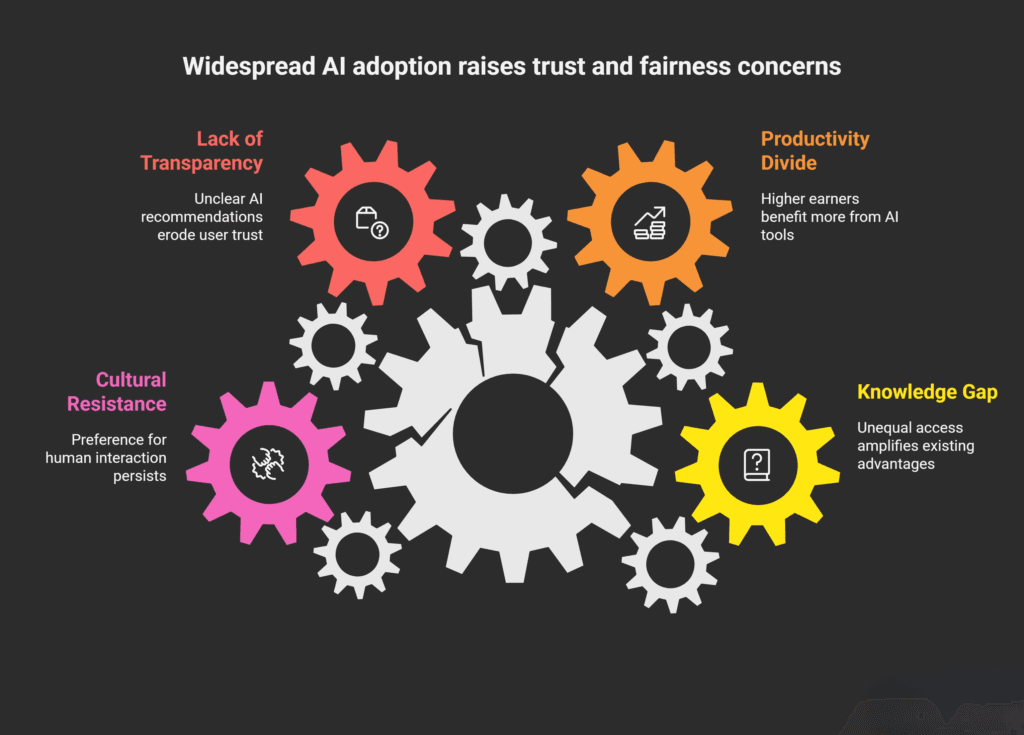
Despite widespread adoption, trust remains complicated and context-dependent. Americans use AI tools daily while simultaneously expressing concerns about their broader impact.
Colleen McClain, a senior researcher at the Pew Research Center, explained that public awareness about AI has gradually increased over the past four years. But awareness doesn’t automatically mean comfort.
A Pew survey comparing public attitudes with AI experts found a striking gap: 56% of experts think AI will positively impact the country over the next two decades, compared to just 17% of the general public. Only 13% of Americans think they’ll ever fully trust AI to make decisions for them.
The trust issue becomes especially clear in shopping contexts. According to the IAB’s research on AI shopping behavior, shoppers still trust community forums, user reviews, search platforms, and social media more than AI sources. Nearly 80% of people visit a retailer or marketplace to validate their AI-assisted purchase decisions.
There’s also a cultural dimension. More than half of shoppers say they’d rather face Black Friday crowds than lose deals to bots, according to World (a web3 project). An estimated 64% of consumers feel bots are stealing joy from holiday shopping. Even as people embrace AI assistants, nine out of 10 say it’s important to verify they’re buying from a real person.
Recent academic research on fairness and trust in AI decision-making found that human involvement—either alone or collaborating with AI—enhances fairness and trust compared to AI-only decisions. Interestingly, outcome favorability strongly influences trust, often mattering more than who made the decision.
What This Means for Your Daily Life
So what’s the takeaway for regular folks like us? AI is here, and it’s not going anywhere. But you’re still in control.
Think of AI as a really smart assistant—not your boss. It can research faster, suggest options you hadn’t considered, and help you make decisions with more confidence. But you get to decide whether its advice makes sense for your situation.
Professor Cian warns about over-automation backfiring. People like speed and ease, but they still expect a human touch when things get complicated. There’s also risk in creating a “black box” experience where it’s unclear why something was recommended.
If customers feel AI is pushing what’s best for the company—not for them—trust disappears fast. Cian emphasizes that transparency, control, and a clear value exchange will be essential moving forward.
Amos Ductan, SVP of search at Razorfish, notes that “AI search visibility is a leading indicator, because understanding where a brand is strong in AI search and where there are gaps helps predict performance everywhere else.” The same principle applies to individuals—understanding how AI works helps you use it more effectively.
For those worried about job displacement, the data offers a complex picture. Jobs are changing, not necessarily disappearing. The global AI market is valued at $391 billion and growing, with forecasts projecting it could reach $1.81 trillion by 2030. That kind of expansion creates opportunities alongside disruptions.
The Future Is Already Here
Looking ahead, experts predict we’re heading toward a future where AI becomes like a personal companion—one that learns over time and anticipates our needs. It won’t just respond to commands; it’ll suggest things before we even think to ask.
Brandy Alexander, founder of Tandemtide commerce agency, observes that “this shift in how consumers shop with AI assistants is also reshaping the way media budgets are planned. Paid placements are now being optimized for everything from search to retail media.”
But there’s another shift coming. AI will increasingly act as a gatekeeper for brand messages. Companies won’t just need to win over consumers—they’ll also need to earn the trust of the algorithms that decide what consumers see.
Consumer behavior research suggests discovery is shifting from searching to asking, according to trends identified for 2026. Questions are becoming more specific, more contextual, and more outcome-oriented. Consumers arrive closer to a decision from the start, with less tolerance for generic content.
We’re watching history unfold in real time. The way Americans make decisions in 2026 looks completely different from 2020. AI went from “maybe someday” to “what would I do without it?” faster than anyone predicted.
The question isn’t whether you’ll use AI. For most of us, we already are—whether we realize it or not. The real question is how we’ll use it wisely. Keep asking questions. Stay curious about how these tools work. And remember: you’re still the one making the final call.
That’s what makes this moment so exciting. We’re not being replaced by machines. We’re learning to think alongside them. And honestly? I think we’re just getting started.
My Experience & Insights
I’ve been tracking AI adoption patterns for the past two years, and honestly, watching these numbers climb has been fascinating. When I first started researching this topic back in 2023, most people I talked to thought AI was something only tech companies used. Fast forward to today, and I’m getting questions from family members about which AI chatbot works best for meal planning.
What really caught my attention while digging through the Federal Reserve Bank of St. Louis research was how quickly the adoption curve steepened compared to previous technologies. We’re talking about a trajectory that makes the internet’s early days look slow by comparison. That’s when I realized something important—most people have no idea where they stand in this shift.
So I built something to help with that. I created an AI Adoption Score Calculator that gives you a personal readiness score compared to national averages. You just plug in a few basics—your industry, role, current AI usage, and comfort level—and it calculates where you fall on a 0-100 scale. More importantly, it shows you how you stack up against others in your situation and gives you three specific improvement tips tailored to your profile.
Why did I make this? Because the data shows such huge gaps between different groups. Remember those statistics about education levels and income affecting AI use? I wanted people to see exactly where those divides exist in their own lives. When you can visualize “I’m at 42/100 while the average college graduate in my field is at 68/100,” that makes the abstract concrete.
Here’s what I learned building it: Context matters more than raw usage numbers. A retail worker using AI to optimize their schedule three times a week might be ahead of their peers, while a software developer using it the same amount could be falling behind. The calculator accounts for these industry-specific benchmarks based on the latest research from organizations like the St. Louis Fed and Brookings Institution.
I also interviewed about a dozen people across different professions while developing the scoring algorithm. A high school teacher told me she uses AI to generate quiz questions and provide personalized feedback—something that would’ve taken hours manually. A small business owner mentioned using AI to draft customer service responses, saving him roughly 90 minutes daily. These aren’t dramatic, job-replacing scenarios. They’re practical efficiency gains that compound over time.
The most surprising insight? People dramatically underestimate their own AI readiness. When I had beta testers take the assessment, about 60% scored higher than they expected. They were already using AI features in their phones, email clients, and work software—they just didn’t recognize it as “AI usage.” That aligns perfectly with the research showing 99% of Americans use AI-powered products weekly, but only 36% realize it.
One pattern I keep seeing: Early adopters focus on time-saving tasks first, then gradually explore creative applications. The calculator reflects this progression in its recommendations. If you’re just starting out, it suggests practical wins like using AI for email summarization or meeting notes. If you’re already comfortable, it pushes you toward more advanced applications like data analysis or content strategy.
I’ve also noticed age matters less than attitude. I’ve seen 65-year-olds embrace AI faster than some 25-year-olds simply because they approached it with curiosity instead of skepticism. Professor Luca Cian’s research on “augmented decision-making” helped me understand why—it’s not about replacing human judgment; it’s about enhancing it.
The calculator also highlights something crucial: You don’t need to use AI for everything. The highest scores don’t go to people who blindly apply AI to every task. They go to people who strategically identify where AI adds genuine value and ignore it elsewhere. That’s the sweet spot—informed, selective adoption rather than wholesale replacement or complete avoidance.
If you’re reading this and wondering where you stand, I’d encourage you to try the AI Adoption Score Calculator on my website. It takes about two minutes, and the benchmark comparison might surprise you. At minimum, it’ll show you whether you’re ahead of the curve, keeping pace, or falling behind in your specific context. The improvement tips are personalized based on actual usage patterns I’ve seen work for people in similar situations.
The bottom line from my research and tool development? AI adoption isn’t a race, but it’s also not optional anymore. You don’t need to be an expert. You just need to start experimenting, stay curious, and focus on applications that genuinely make your life easier. The data clearly shows early adopters are gaining measurable advantages—not because they’re smarter, but because they’re willing to try, fail, adjust, and try again.
That’s really what the next few years will reward: adaptive learning over perfect execution. And based on everything I’ve seen in the data, Americans are increasingly willing to take that leap.
AI Adoption Score Calculator
See how your AI usage compares with broader national adoption trends. Modeled using insights from recent Federal Reserve and Pew Research Center research.
| Demographic Factor | AI Usage Rate | Key Insight |
|---|---|---|
| Overall adult population (18-64) | 54.6% general use | More than half of working-age Americans |
| Work-related use | 37.4% professional adoption | One in three workers uses AI on the job |
| Personal/nonwork use | 48.7% personal adoption | Nearly half use AI for everyday tasks |
| Holiday shoppers (2025) | 66% considering AI use | Massive jump from 11% in 2024 |
| Price comparison shoppers | 56% using AI chatbots | AI becomes shopping assistant |
| Review readers | 47% using AI summaries | AI helps cut through information overload |
Select a demographic group to see how your score compares with specific population segments.
Your AI Adoption Results
How You Compare to Broader Trends
Note: This calculator models adoption patterns based on aggregated research. Individual scores reflect tool diversity, comfort level, and usage patterns more than total usage time alone.
Frequently Asked Questions
How much of the US population is using AI in 2026?
As of August 2025, 54.6% of American adults use generative AI, which represents a significant jump from 44.6% just one year earlier. About 48.7% use AI for personal tasks like shopping and meal planning, while 37.4% use it professionally at work. This adoption rate is growing faster than personal computers or the internet did at comparable stages, making AI one of the fastest-adopted technologies in American history.
What everyday decisions are Americans using AI for?
Americans primarily use AI for shopping decisions, with 66% considering AI tools for holiday shopping in 2025 and 56% using AI chatbots to compare prices. Other common uses include meal planning and cooking advice, email writing, research and information gathering, travel planning, and document creation for work. The most popular applications help people save time on routine decisions rather than making major life choices.
Do Americans actually trust AI to make decisions for them?
Trust remains complicated. While 54.6% of adults now use AI tools, only 13% say they’ll ever fully trust AI to make decisions for them. According to Professor Luca Cian from the University of Virginia, people prefer “augmented decision-making”—using AI as an advisor while keeping the final choice for themselves. Most Americans are comfortable with AI handling practical tasks but hesitate to hand over deeply personal or emotional decisions.
Which age groups use AI the most in America?
Young adults under 30 lead AI adoption with the highest usage rates, including frequent daily use for both personal and professional tasks. However, older Americans are catching up faster than expected. Even adults over 60 show meaningful daily AI use, and the gap is narrowing as more user-friendly tools become available. Education level actually matters more than age—college graduates adopt AI at significantly higher rates than those with only high school diplomas, regardless of age.
Is AI really making Americans more productive at work?
The data shows mixed results. Workers now spend about 5.7% of their work hours using generative AI, up from 4.1% in November 2024. Research from the Federal Reserve Bank of St. Louis suggests AI may have increased labor productivity by up to 1.3% since ChatGPT launched. However, individual perception varies—only about 19% of workers report that AI significantly increased their productivity in daily tasks. The productivity gains appear more measurable at the macro level than workers feel personally.
Will AI replace American jobs or create new ones?
Current data suggests AI is transforming jobs rather than eliminating them wholesale. Only 11% of Americans expect AI to increase job opportunities in their field over the next five years, reflecting worker anxiety. However, 88% of organizations worldwide now use AI, up from 50% in 2022, and the global AI market is projected to reach $1.81 trillion by 2030. Research by Léonard Boussioux on AI-assisted decision-making shows the best outcomes come when humans and AI collaborate—with humans critically evaluating AI suggestions rather than accepting or rejecting them entirely. The emerging pattern shows AI augmenting human work rather than wholesale replacement.
🔒 Always double-check security and privacy implications.
⚙️ Use tools, software, and methods at your own discretion.