

🔒 Always double-check security and privacy implications.
⚙️ Use tools, software, and methods at your own discretion.
How to Create AI-Free Zones for Deep Focus and Real Creativity is something I’ve been thinking about a lot lately because my brain feels a bit crowded. Have you ever felt like your phone is finishing your sentences before you even think them? It’s helpful, sure, but it can also make our own “creative muscles” feel a little weak. When we rely on a chatbot to brainstorm a gift idea or write a note to a friend, we might be missing out on that spark that makes us uniquely us.
I want to share why stepping away from the “autocomplete” life is so important. We aren’t just trying to be productive; we’re trying to be original. Let’s look at how we can build spaces where the only “intelligence” is the one between your ears.
- Why Our Brains Need a “Tech Timeout”
- How to Create AI-Free Zones for Deep Focus and Real Creativity
- Comparing the “AI Way” vs. the “Human Way”
- ⚡ AI vs. human strengths
- The Experts Weigh In
- Practical Steps to Build Your Zone
- The Long-Term Benefit: “Originality Insurance”
- My Experience & Insights
- 🧘 Deep Focus Timer beta
- Frequently Asked Questions.
Why Our Brains Need a “Tech Timeout”

When we use AI for everything, we tend to skip the “messy middle” of thinking. That messy part is actually where the magic happens. Real creativity often comes from being a little bored or struggling with a hard problem. If an algorithm solves the problem in two seconds, we don’t get that “aha!” moment.
Experts like Cal Newport, a computer science professor at Georgetown University, have written extensively about “deep work.” He argues that the ability to focus without distraction is becoming a “superpower” in our economy. If we are always plugged into tools that do the heavy lifting, we lose the stamina to think deeply on our own.
The Science of “Boredom”
It sounds funny, but being bored is actually good for you. When your mind wanders, it starts making weird, cool connections. This is what researchers call the “Default Mode Network” of the brain. If you fill every quiet gap with a quick AI search or a social media scroll, you never give that network a chance to turn on.
How to Create AI-Free Zones for Deep Focus and Real Creativity

To get back to that raw, human creativity, we need to set some boundaries. It’s not about hating technology; it’s about making sure you are the boss of the technology, not the other way around.
1. The “Paper-Only” Hour
One of the easiest ways to start is by picking one hour a day where you leave all screens in another room. I like to call this the “Analog Hour.” Grab a notebook and a pen. There’s something about the physical act of writing that slows your brain down just enough to let better ideas surface.
Austin Kleon, the author of Steal Like an Artist, suggests having two desks: one “digital” desk with your computer, and one “analog” desk with markers, paper, and scissors. When you move to the analog desk, your brain knows it’s time to play and create without a “delete” key or an “undo” button.
2. Nature Walks Without Podcasts
We often think we’re being smart by “multitasking.” We walk the dog while listening to an AI-generated summary of a book. But true inspiration often hits when we’re just looking at the trees. Try walking for 20 minutes with nothing in your ears. Let the sounds of the neighborhood be your soundtrack. You’ll be surprised at what ideas pop up when you aren’t feeding your brain constant data.
3. Setting Boundaries in the Office
If you work in an office, it’s easy to let tools like ChatGPT or Copilot take over your drafting process. While these are great for chores (like formatting a table), they can be “creativity killers” for big-picture strategy.
I’ve started a rule for myself: Brainstorm first, Google second. I spend 15 minutes writing down every “bad” idea I have before I ever ask an AI for suggestions. This ensures that the foundation of the work is mine, not a prediction based on the whole internet.
Comparing the “AI Way” vs. the “Human Way”
It helps to see the difference between what machines do well and what we do well. Use this table to see where you should lean on technology and where you should lean on yourself.
⚡ AI vs. human strengths
| Task category | AI strength (the “fast” way) | Human strength (the “creative” way) |
|---|---|---|
| 🔍 Problem Solving | Sorting through huge amounts of data quickly. | Using personal “gut feelings” and life experience. |
| ✍️ Writing | Fixing grammar and making things sound professional. | Adding “voice,” humor, and weird personal stories. |
| 🎨 Art & Design | Copying styles and making “perfect” patterns. | Making intentional “mistakes” that feel soulful. |
| 📚 Learning | Summarizing facts into bullet points. | Connecting a new idea to a memory from childhood. |
The Experts Weigh In
It’s not just me who feels this way. Many people who study the mind are worried about “cognitive offloading.” This is a fancy way of saying we let our gadgets do our thinking for us.
Dr. Maryanne Wolf, a scholar at UCLA, focuses on how the “reading brain” changes in a digital world. She points out that if we only read quick bits of info, we lose the “deep reading” skills needed for empathy and critical thinking. To stay creative, we have to practice being patient with long ideas.
Similarly, Jaron Lanier, a pioneer in virtual reality, often talks about how we shouldn’t let computers define who we are. He suggests that the more we act like “users” of an interface, the less we act like independent individuals. By carving out AI-free zones, we are essentially “taking back” our own personalities.
Practical Steps to Build Your Zone
Ready to try it? Here is a simple checklist to get your first “Human-Only” zone started:
- Pick a Physical Spot: Choose a chair, a park bench, or a corner of the library. This is your “No-AI Zone.”
- Leave the Phone: If you can’t leave it, put it in “Do Not Disturb” mode and keep it in your bag.
- Bring “Dumb” Tools: Pens, pencils, clay, paint, or a physical book.
- Set a Timer: Start with just 15 minutes. It might feel itchy or boring at first. That’s a good sign! It means your brain is starting to “reboot.”
- Forgive Yourself: If you accidentally check your phone, don’t sweat it. Just put it back down and return to your thoughts.
The Long-Term Benefit: “Originality Insurance”
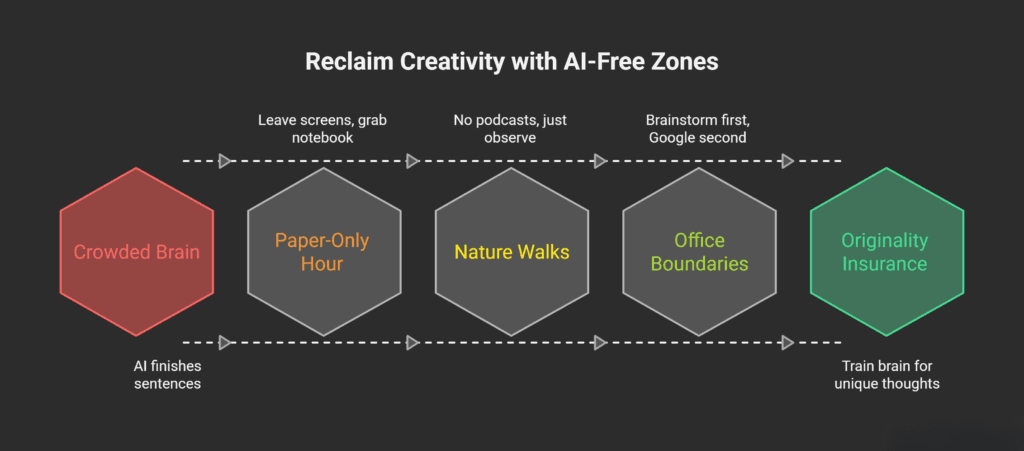
The world is going to be flooded with AI content. Soon, things that look “perfect” might actually feel a bit boring because they lack that human touch. By practicing these AI-free zones, you are essentially buying “originality insurance.” You are training your brain to think in ways that a machine cannot.
You’ll find that you have better conversations, more unique ideas at work, and a deeper sense of calm. Plus, when you do go back to using AI, you’ll be much better at directing it because you’ll know exactly what you want to say.
So, what do you think? Could you spend 20 minutes today just sitting with a notebook? It might be the most productive 20 minutes of your week.
My Experience & Insights
While researching the science of focus for this article, I came across several studies showing that even the mere presence of a smartphone reduces our cognitive capacity (brain power). It’s like a small part of our mind is constantly on “standby,” waiting for the next ping.
I’ve felt this myself. There were days when I’d sit down to write, and within five minutes, I’d find myself checking an AI-generated summary of a news thread. I wasn’t being lazy; my brain was just seeking a quick hit of “easy” information. To fix this, I decided to experiment with my own habits. I started practicing what Dr. Gloria Mark, a Professor of Informatics at UC Irvine, calls “attention spans.” Her research highlights how our average attention span on a screen has shrunk to just 47 seconds.
To help me—and now you—fight back against this trend, I developed a simple tool called the Deep Focus Timer.
I built this specifically because most phone timers are on your phone, which is the very source of the distraction. This web-based tool is designed to help you rebuild your attention stamina through “notification-free” intervals. Here is how I use it to get back into the flow:
- Custom Work Durations: I usually start with 25 minutes of “AI-Free” time, then slowly increase it as my focus muscle gets stronger.
- The “Urgent” Distraction List: If a random thought pops up (like “Did I answer that email?”), I don’t leave the tab. I type it into the distraction list within the tool to deal with later.
- Rebuilding Stamina: The goal isn’t to work for eight hours straight; it’s to teach your brain that it can survive without a digital “answer” for short bursts of time.
Using this tool changed my writing process. Instead of reaching for a chatbot to “fill in the blanks” when I got stuck, the timer kept me in my chair until my own brain found the solution. It’s a bit like lifting weights—it’s hard at first, but the mental clarity you feel afterward is worth the effort.
🧘 Deep Focus Timer beta
- No distractions logged yet — great focus!
Frequently Asked Questions.
What exactly is an “AI-Free Zone”?
An AI-Free Zone is a specific time or physical space where you intentionally choose not to use any generative AI tools or digital assistants. This doesn’t mean you are “anti-tech.” It just means you are creating a boundary to ensure your original thoughts and “gut feelings” stay sharp. Think of it like a “digital sanctuary” for your brain.
Is using AI actually bad for my creativity?
Not necessarily, but it depends on when you use it. If you use AI to brainstorm before you’ve tried to think for yourself, you might experience “anchoring bias,” where your brain gets stuck on the AI’s suggestions and stops looking for unique alternatives. Research on Cognitive Offloading suggests that relying too much on external tools can make it harder to remember or process information deeply.
How long should I stay in an AI-Free Zone to see results?
You don’t need hours to make a difference. Even 15 to 20 minutes of “deep work” without notifications or chatbots can help reset your focus. The key is consistency. Much like physical exercise, doing it daily—even in small bursts—builds up your mental stamina over time.
Can I still use “dumb” technology in these zones?
Absolutely. The goal is to avoid generative or distractive AI. Using a basic digital watch, a simple calculator, or an old-school MP3 player is usually fine. The “red flags” are tools that try to finish your sentences, predict your needs, or show you an endless feed of content.
My job requires AI; how can I create these zones at work?
We recommend the “Draft First” rule. Use your AI-Free Zone to write your initial thoughts, strategy, or messy first draft on paper or in a simple text editor with no internet. Once your core idea is solid, then bring in AI to help with formatting, grammar, or data analysis. This ensures the “soul” of the project is yours.
What are the best “analog” activities to spark real creativity?
Activities that engage your senses are best. This includes things like:
Handwriting in a journal.
Physical hobbies like gardening or painting.
Walking in nature without headphones.
Playing a musical instrument. These tasks force your brain to focus on the “here and now,” which is exactly where original ideas are born.
🔒 Always double-check security and privacy implications.
⚙️ Use tools, software, and methods at your own discretion.